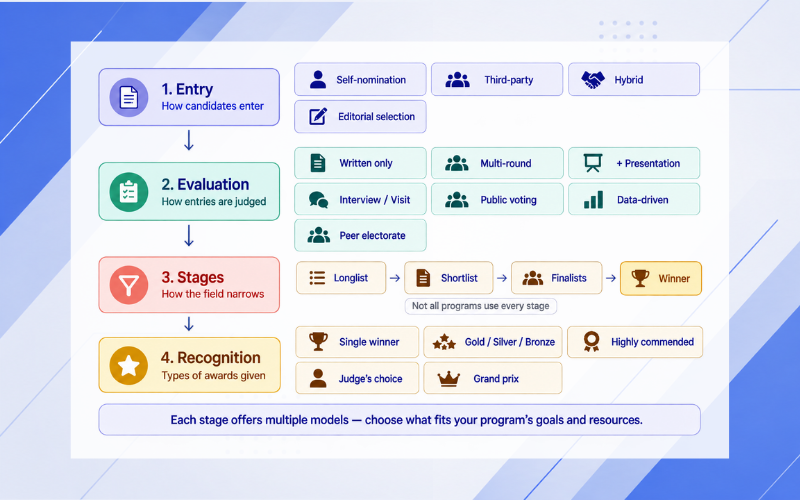
Running an awards program for the first time can feel overwhelming, because you know you want to recognise excellence in your industry or your community, but the mechanics of actually selecting winners look like a maze of options. Should you use judges, a public vote, or a vote by your own membership? What’s the difference between a shortlist and a finalist? Do you need several rounds of evaluation, or will one do the job?
The honest answer is that there’s no single correct way to run an awards program, and the right approach depends on your goals, your resources and what kind of recognition will feel meaningful to your winners as well as credible to everybody watching. This guide walks through every major process model, explains the terminology, and helps you work out which structure fits.
On this page
- The stages, from entry to winner
- How candidates enter
- The core judging models
- Special award types
- Choosing your scoring method
- Building your process
The stages, from entry to winner
Before getting into specific models it helps to know the vocabulary, because not every program includes every stage and knowing what each term means lets you design something that suits your situation rather than copying someone else’s.
The journey starts with nominations or entries, where candidates are put forward for consideration. Many programs then create a longlist, which is the first cut from all submissions, and being longlisted is a genuine achievement in itself, since it signals that an entry stood out from dozens or even hundreds of others.
The shortlist narrows things further, usually to somewhere between three and ten entries per category, and when you announce one you’re telling the world these are your serious contenders. Some programs then name finalists as a separate stage, representing the final three to five candidates competing for the top prize, though in practice a lot of programs use “shortlist” and “finalist” interchangeably. Programs running multiple judging rounds tend to treat them as genuinely distinct.
Then come your winners. Some programs name one per category while others award tiers such as gold, silver and bronze, or recognise a winner alongside “highly commended” entries that deserve acknowledgement even though they didn’t take the top spot.
How candidates enter
The first structural decision you’ll make is how candidates get into the program at all, and there are four approaches with quite different characters.
Self-nomination is the most common model for industry and business awards, where companies or individuals submit their own entries by completing an application form and usually paying a fee. This generates revenue, ensures you receive detailed information about each entry, and puts the work of articulating an achievement onto the person who actually knows about it. The downside is that it can feel self-promotional, and some genuinely worthy candidates never enter because they’re too modest or simply too busy.
Third-party nomination requires somebody else to put a candidate forward, so a colleague, client or industry peer submits the nomination and the nominee may then be asked for supporting information. This feels more prestigious because it implies external recognition rather than self-promotion, which makes it a natural fit for individual achievement and lifetime contribution categories. The challenge is that it needs far more outreach to generate nominations in the first place, and you’ll miss worthy people simply because nobody thought of them.
Hybrid nomination accepts both, which maximises your candidate pool while preserving the prestige of peer recognition. Many programs that run on self-nomination also encourage clients and colleagues to submit supporting testimonials, which achieves much the same effect without a separate process.
Editorial or automatic selection removes nomination entirely, with the organisers identifying candidates from market data, industry knowledge or defined performance metrics. It’s less common but can be powerful where you have access to data that genuinely reflects excellence, and it eliminates both entry fees and self-promotional pitching. The trade-off is that it demands real research capacity and invites accusations of bias if your methodology isn’t transparent.
The core judging models
Once you have candidates, the question becomes how you’ll evaluate them, and this is where the real variety appears, as well as where your choices most affect how the program is perceived.
Single-round written judging
The simplest approach has judges reviewing written submissions and scoring them against defined criteria, so entries come in, judges read them, scores are calculated and winners emerge. It’s efficient and it scales, which makes it popular with programs handling large volumes or working within limited resources.
The limitation is that judges can only assess what’s on the page, with no way to verify a claim, form a view of the people behind the entry, or dig deeper when something reads oddly.
This model works best where your criteria are straightforward, your entrants are roughly comparable in their ability to describe their own work, and the stakes are moderate enough that a paper evaluation feels proportionate.
Multi-round written judging
Adding a second round produces something considerably more rigorous. A screening panel reviews everything in round one and identifies a shortlist, then a different or partly overlapping panel evaluates those shortlisted entries in more depth in round two, often against more detailed criteria and with more time per entry.
This improves quality because the judges making the final decisions are only looking at genuinely competitive entries rather than wading through the weaker submissions, and it lets you deploy different expertise at different stages, generalist screeners first, specialists second.
The cost is time and coordination, since you’re managing two judging phases and a handover between them, which extends your overall timeline. Where credibility is the priority, that’s usually an investment worth making.
Written entry plus live presentation
When your headline categories need to feel genuinely prestigious, inviting finalists to present to a judging panel adds a powerful verification layer. The judges will already have read the written submission, so the presentation isn’t about repeating what’s on paper, it’s a chance for finalists to bring their story to life, show they understand their own achievements, and answer questions that probe the claims.
This turns judging from a paper exercise into a conversation, because judges can test whether the person in front of them actually understands the figures they’ve cited, explore the decisions behind the results, and assess qualities such as depth of knowledge and credibility that written entries simply can’t convey.
Tip from the field: Awards strategist Donna O’Toole points out that by the time finalists walk into the room, judges have already read the entry, they know the story and the claims. The presentation is about proving it’s real. Can you confidently explain the decisions you made? Do you understand the numbers behind your results? Judges aren’t looking for a polished, rehearsed performance; they want genuine knowledge, credibility, and passion. The Q&A often matters most, a challenging question isn’t a sign something went wrong, it means judges want to understand your story in greater depth.
Live judging days need serious logistics, particularly if finalists are travelling to take part, though virtual presentations have become far more common and preserve most of the interactive value while lowering the barrier to participation. Programs using this model often reserve it for their most competitive categories and use something simpler elsewhere.
Interview and site visit judging
Taking verification further still, some programs send judges to meet finalists in their own environment, visiting offices, touring facilities and speaking to team members beyond whoever wrote the entry. That gives you insight into whether an organisation genuinely embodies the excellence it claims that no other method can match.
Site visits are resource-intensive and only practical with a small number of finalists and judges willing to travel, so they suit employer awards, operational excellence categories, and anything where culture and environment matter as much as outcomes.
Even without a physical visit, a structured interview by video call adds real depth, since judges can prepare questions from the written entry and probe whatever looked unclear or unsubstantiated.
Peer electorate voting
Some of the best-known awards in the world use neither a judging panel nor a public vote, but something between the two, a vote by the entire qualified membership of an industry body. The Academy Awards work this way, with several thousand film professionals voting in their own craft categories, and the Emmys and BAFTA follow broadly similar models.
The appeal is that it combines scale with expertise, because you get the breadth of a vote while restricting the electorate to people who actually work in the field. That makes the result much harder to dismiss as a popularity contest, and harder to manipulate than an open public vote, since nobody can mobilise a network that isn’t eligible to participate in the first place.
What it requires is a real membership to draw on, which is what makes this model natural for trade associations and professional bodies and impractical for almost everybody else. You need enough qualified voters for the result to carry weight, a reliable way of verifying who’s eligible, and ideally some structure restricting people to the categories they’re actually competent to judge.
Public voting
At the opposite end from expert judging, the audience decides: votes are cast, tallied, and the entry with most support wins. This maximises engagement and creates natural marketing momentum as nominees encourage their networks to take part.
It works beautifully for people’s choice awards where popular opinion genuinely is the point, and it generates buzz, extends your reach and makes winners feel validated by their own community. The risks are just as substantial, manipulation through bots or coordinated campaigns, a popularity contest that favours large organisations over excellent small ones, and outcomes that may not reflect merit at all.
Hybrid judging models
Many programs combine approaches to get the strengths of each, and the most common structure has expert judges creating a shortlist before public voting opens among those finalists, which ensures only credible candidates reach the ballot while still giving your audience a voice in the result.
The weighting between the two varies. Some programs split it fifty-fifty while others weight expert opinion more heavily, perhaps seventy-five per cent judges to twenty-five per cent public, and the right balance depends on whether you’re optimising for credibility or for engagement.
Another approach uses public voting for a single designated people’s choice category while expert judges decide everything else, which acknowledges the value of community input without letting popularity override merit across the whole program.
Data-driven selection
An emerging model removes human judgement altogether and determines winners through objective metrics, so rather than asking candidates to describe their achievements it measures those achievements directly using market data, performance analytics or other quantifiable indicators.
This requires access to reliable metrics and complete transparency about methodology, but when it’s done well it eliminates the self-promotional element entirely, there’s nothing to pitch and no narrative to craft, so winners are determined by what they did rather than by how well they wrote about it.
It isn’t appropriate everywhere, since plenty of excellence can’t be reduced to numbers, but for categories where objective measurement is genuinely possible it’s a compelling alternative to conventional judging.
Comparing the models
Each model carries a different profile of entry volume, resource intensity, credibility and engagement, and the trade-offs are easier to see side by side than one after another. Our process models comparison matrix sets them all out against those criteria, alongside nomination models, scoring methods and terminology.
Special award types
Beyond your standard category winners, four recognition formats can add depth to a program.
Judge’s choice
Lets your panel recognise an exceptional entry that stood out beyond the normal scoring, a company whose innovation was remarkable even though it didn’t win its category, or an individual whose contribution deserves acknowledgement. These discretionary awards let judges exercise their expertise and often produce the most memorable moment of a ceremony.
Tiered awards
Gold, silver and bronze within a single category, which lets more entrants claim winner status and gives you more to talk about afterwards. It works particularly well in competitive categories where several entries are genuinely excellent and picking just one would feel arbitrary.
Highly commended
Acknowledges entries that performed strongly without quite winning, which matters most in close competitions and gives near-winners something real to celebrate and promote rather than nothing at all.
Grand prix
The single best entry across your entire program regardless of category, usually decided by comparing the category winners against each other. It creates a headline moment for your ceremony and gives your communications a clear lead.
Choosing your scoring method
However you structure the judging, you’ll need to decide how judges turn their assessments into results, and there are four main options.
- Numeric scoring has judges assigning a number on a defined scale, which is intuitive and produces clear differentiation, though judges tend to cluster their scores in predictable ranges and that makes closely matched entries hard to separate.
- Weighted criteria gives different evaluation factors different importance, which lets you emphasise what matters most but needs careful design to avoid distortions nobody intended.
- Pass/fail screening asks only whether an entry meets a threshold, which works well in an initial round where you’re separating competitive entries from weak ones rather than ranking anything.
- Ranked choice has judges order entries by preference instead of scoring them individually, and because it forces direct comparison it’s often more reliable than absolute scoring when the entries are close in quality.
Many programs combine these across stages, using pass/fail for initial screening, weighted numeric scoring for the shortlist, and ranked preferences for the final deliberation among the top contenders.
Building your process
With the models understood, you can design something that fits your actual situation, and the place to start is what you’re trying to achieve. If credibility is paramount and your categories are high-stakes, lean towards multi-round judging with presentations or interviews. If engagement and community participation matter more, bring in public voting either on its own or as part of a hybrid. And if you have access to objective metrics and want to remove subjective pitching altogether, look seriously at data-driven selection.
Then weigh your practical constraints, because how many entries you expect, how many judges you can recruit and coordinate, and what timeline you’re working to will all rule things out. A five-stage process with site visits and live presentations isn’t realistic if you’re launching in two months with a small team.
And if you’re a membership body, look at the peer electorate model before anything else, because you already have the one thing it requires and most programs don’t.
Whatever you settle on, document it and tell your entrants. Transparency about process builds trust, manages expectations and protects you against accusations of unfairness, and when people understand how winners were selected they’re far more likely to respect the result, and to come back and enter again next year.
Frequently Asked Questions
The number of stages should reflect the volume of entries and the depth of evaluation required. A program with around 50 entries may be able to move directly from entries to finalists and winners, while a program receiving hundreds of submissions may need a longlist and shortlist to keep judging manageable.
Longlists, shortlists and finalist stages can also create additional recognition opportunities, but extra stages should only be added when the organisers have the resources and time to run them properly.
A shortlist typically narrows the field to around three to ten serious contenders per category. Finalists may represent a further reduction to the final three to five candidates competing for the award.
Some awards programs use “shortlisted” and “finalist” interchangeably. Programs with multiple judging rounds are more likely to treat them as separate stages, with the shortlist preceding the finalist selection.
Self-nomination works particularly well for business and industry awards because entrants can provide detailed evidence about their achievements, and entry fees can generate revenue. Third-party nominations can carry greater prestige because recognition originates from a colleague, client or industry peer.
A hybrid nomination process can accept both types, widening the candidate pool while retaining opportunities for peer recognition.
Live presentations are particularly valuable for prestigious or highly competitive categories where judges need to verify claims and explore achievements beyond the written entry. After reviewing the submission, judges can question finalists about their results, decisions and evidence.
Presentations commonly last 15–30 minutes and combine prepared remarks with panel questions. Virtual presentations can provide much of the same interactive value while reducing travel and participation barriers.
hybrid awards process can use expert judges to select credible finalists before opening a public vote. The final result can then combine judges’ scores with public voting, such as a 50/50 split or a weighting that gives expert judging greater influence.
Another option is to reserve public voting for a dedicated people’s choice award while using expert judging for all other categories. This creates community engagement without allowing popularity to determine every award.
Public voting should include safeguards such as limits on votes per person or IP address, bot detection and email verification. Voting rules should also be published before voting begins so participants understand how votes are counted.
Organisers should decide in advance whether public votes determine the winner outright or contribute to a combined result with expert judging.
Different scoring methods can serve different purposes throughout an awards process. Pass/fail assessment works well for initial screening, weighted numeric scoring can evaluate shortlisted entries against defined priorities, and ranked choice can help judges distinguish between closely matched finalists.
Combining scoring methods across rounds can be more effective than relying on a single system from initial entry through to the final decision.
Data-driven selection works best when excellence can be measured using reliable, objective metrics such as market data, performance analytics or other quantifiable indicators. It removes the advantage of persuasive entry writing because winners are determined by measurable performance rather than how effectively candidates present their achievements.
The approach requires reliable data and a transparent methodology, and it is unsuitable for qualities that cannot meaningfully be reduced to numerical measures.
“Highly commended” recognises strong entries that came close to winning, while tiered awards such as gold, silver and bronze formally recognise several levels of achievement within the same category.
A grand prix serves a different purpose: it identifies the single best entry across the entire awards program, typically by comparing the individual category winners.
The judging process should be based on the program’s goals, expected entry volume, available judges, resources and timeline. Programs prioritising credibility can use multi-round judging, presentations or interviews, while programs focused on community engagement can incorporate public voting. Objective performance categories may suit data-driven selection.
A new program can begin with a relatively simple process and add shortlisting, voting or live judging in later years. Whatever structure is chosen, documenting and communicating the selection process helps build trust in the results.