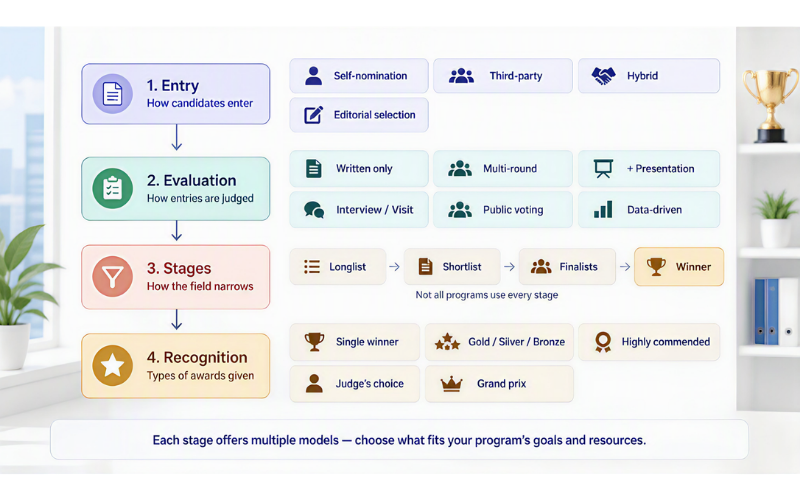
A quick-reference guide for awards program organisers.
Judging models at a glance for industry awards
How each model works
| Model | How it works | Best for |
|---|---|---|
| Single-round written | Judges score written entries against criteria; scores aggregated to determine winners | Simple programs, limited budgets, straightforward categories |
| Multi-round written | Round 1: screening panel creates shortlist; Round 2: final panel evaluates shortlisted entries in depth | Higher-stakes recognition, large entry volumes |
| Written + live presentation | Written entry judged first; shortlisted finalists present to judges and answer questions | Headline categories, premium awards, verification needed |
| Interview or site visit | Judges meet finalists virtually or visit their premises to verify claims and assess culture | Employer awards, operational excellence, culture-focused categories |
| Public voting only | Votes cast by audience; highest vote count wins | People’s choice, fan favourites, community-driven recognition |
| Hybrid (judges + public) | Expert judges create shortlist or provide weighted score; public voting adds engagement layer | Balancing credibility with community participation |
| Data-driven | Winners determined by objective metrics and algorithms; no submissions or pitches | Performance categories where objective measurement is possible |
| Data-informed expert judging | Judges evaluate entries using objective metrics (performance data, complaint records, safety scores) alongside expert assessment; decisions grounded in verifiable outcomes, not just self-reported claims | Values-based awards, responsible gambling recognition, categories where trust and outcomes matter more than commercial success |
What each model demands and delivers
| Model | Entry volume | Resource needs | Credibility | Engagement |
|---|---|---|---|---|
| Single-round written | Any | Low | Moderate | Low |
| Multi-round written | Medium to high | Medium | Good | Low |
| Written + live presentation | Low to medium | High | Very high | Medium |
| Interview or site visit | Low | Very high | Excellent | Medium |
| Public voting only | Any | Low | Low to moderate | Very high |
| Hybrid (judges + public) | Medium | Medium | Good | High |
| Data-driven | Any | Low to medium | Very high | Low |
Nomination models compared
| Model | How it works | Advantages | Challenges | Best for |
|---|---|---|---|---|
| Self-nomination | Candidates submit their own entries | Revenue generation, detailed applications, entrant controls narrative | Can feel self-promotional, may miss modest candidates | Industry and business awards |
| Third-party nomination | Peer, colleague, or client nominates candidate | Feels more prestigious, implies external recognition | Requires outreach to generate nominations, may miss worthy candidates | Individual achievement, lifetime contribution |
| Hybrid | Both self and third-party nominations accepted | Maximises candidate pool, flexibility | More complex to manage | Most general programs |
| Editorial selection | Program organisers identify candidates based on data or expertise | Eliminates entry fees and pitching, objective selection | Requires research capacity, risks bias accusations | Data-rich categories, curated recognition |
Scoring methods compared
| Method | How it works | Strengths | Weaknesses | Best used for |
|---|---|---|---|---|
| Numeric scale | Judges assign scores (e.g. 1–10) per criterion | Intuitive, produces clear rankings | Score clustering, inconsistent scale interpretation | Standard category judging |
| Weighted criteria | Different criteria carry different point values | Emphasises priorities, reflects what matters most | Requires careful design, can create unintended distortions | Complex evaluations with clear priorities |
| Pass/fail | Binary decision: meets threshold or doesn’t | Simple, efficient, clear standards | No nuance, no differentiation among passing entries | Initial screening rounds |
| Ranked choice | Judges order entries by preference | Forces direct comparison, handles close competitions well | Doesn’t capture magnitude of differences | Final deliberations, tie-breaking |
| Calibration scoring | Judges score samples first; scores adjusted for individual tendencies | Accounts for strict versus lenient judges | Requires statistical expertise, sufficient entry volume | Large judging panels |
Award stage terminology
| Term | What it means | Typical numbers |
|---|---|---|
| Longlist | First cut from all submissions; an achievement in itself | 10–20 per category |
| Shortlist | Narrowed selection of serious contenders | 3–10 per category |
| Finalists | Final candidates competing for the prize (sometimes used interchangeably with shortlist) | 3–5 per category |
| Winner | Top recognition in the category | 1 per category |
| Gold/silver/bronze | Tiered winner system recognising multiple levels | 3 per category |
| Highly commended | Recognition for strong entries that didn’t win | 1–3 per category |
| Grand prix | Best overall entry across entire program | 1 per program |
| Judge’s choice | Discretionary award selected by judges outside normal scoring | 1–2 per program |
Quick decision guide
Choose single-round written judging if
- You’re launching a new program with limited resources
- Your categories are straightforward with clear criteria
- Entry volume is manageable for your judging panel
- Speed and efficiency are priorities
Choose multi-round written judging if
- You expect high entry volumes
- You want to reduce the burden on final judges
- Credibility matters and you need a rigorous process
- You have time for a longer evaluation cycle
Choose live presentation judging if
- You need to verify claims and assess credibility
- Your headline categories warrant premium treatment
- You want judges to interact directly with finalists
- You’re willing to invest in logistics and coordination
Choose public voting if
- Community engagement is a primary goal
- You want to generate marketing momentum
- The category is genuinely about popularity or fan preference
- You have safeguards against vote manipulation
Choose hybrid judging if
- You want both credibility and engagement
- Expert judgement should carry more weight than popularity
- You want a “people’s choice” element alongside merit-based selection
- Your audience values having a voice in outcomes
Choose data-driven selection if
- Objective performance metrics are available
- You want to eliminate self-promotional pitching
- Transparency and verifiability are paramount
- The category measures quantifiable achievements
Third-party auditors: adding credibility
| Auditor role | What they do | When to consider |
|---|---|---|
| Process auditor | Verifies that published judging process was followed correctly | High-stakes programs, controversy prevention |
| Vote auditor | Monitors public voting for manipulation and validates results | Public voting programs, large audiences |
| Score adjudicator | Oversees score calculation and confirms winners were correctly determined | Programs where accuracy is critical |
| Full oversight | Involved throughout process, from judge selection to winner announcement | Premium programs seeking maximum credibility |
Red flags and green flags
Green flags — credibility markers
- Third-party auditor involvement
- Named judges with relevant expertise
- Published criteria and scoring methodology
- Conflict of interest policies
- Multi-stage evaluation process
- Live judging with Q&A
Red flags — credibility concerns
- Sponsorship levels correlate with shortlisting or winning
- No published judging criteria
- Same companies win repeatedly regardless of entries
- “Pick your own award” offers
- No verification of claims
- Winner certificates sold after the fact
Frequently Asked Questions
Calibration scoring is a method designed to account for differences between strict and lenient judges. Judges first score sample entries, allowing their individual scoring tendencies to be identified and adjusted when results are calculated.
It is most useful for large judging panels with enough entries to support meaningful statistical calibration, but it requires greater statistical expertise than conventional numeric scoring.
A third-party auditor is worth considering when an awards program is high-stakes, uses public voting, requires particularly accurate score calculation, or wants to demonstrate a high level of independence and credibility.
The auditor's role can range from confirming that the published judging process was followed to monitoring voting, checking score calculations or providing oversight throughout the entire awards process.
A vote auditor monitors public voting for manipulation and validates the results. This provides an additional layer of scrutiny when an award attracts a large voting audience or when the outcome depends heavily on public participation.
Vote auditing is particularly relevant for public-voting programs where organisers want greater confidence that the declared winner reflects legitimate votes.
Interview or site visit judging is rated as offering excellent credibility because judges can meet finalists, verify claims and assess factors such as workplace culture directly. Written entries followed by live presentations also provide very high credibility by allowing judges to question finalists.
Both approaches require substantially more resources than written-only judging, so they are generally best suited to a relatively small number of finalists or premium categories.
Multi-round written judging is particularly well suited to medium-to-high entry volumes. A screening panel first reduces the submissions to a shortlist, after which a final panel can concentrate on evaluating the strongest candidates in greater depth.
This structure reduces the burden on final judges while providing a more rigorous process than single-round written judging.
Credibility markers include named judges with relevant expertise, published judging criteria and scoring methods, conflict-of-interest policies, multi-stage evaluation and live judging with questions and answers.
Independent third-party auditor involvement can provide an additional credibility signal by introducing external oversight of the awards process.
Potential credibility concerns include sponsorship levels appearing to influence shortlisting or winning, unpublished judging criteria, a lack of verification for entrants' claims and the same companies repeatedly winning regardless of the entries.
Other red flags include offers that effectively allow organisations to pick their own award and programs that sell winner certificates after the result.
Ranked-choice scoring is particularly useful during final deliberations and tie-breaking. Instead of assigning independent numerical scores, judges place competing entries in order of preference, forcing direct comparison between them.
This can work well when finalists are closely matched, although ranking does not show how much better one entry is than another.
A process auditor checks whether an awards program followed its published judging procedures correctly. This can be valuable for high-stakes awards or where organisers want to reduce the risk of disputes about how judging was conducted.
A score adjudicator has a narrower role focused on calculations, overseeing how scores are processed and confirming that the correct winners were determined from the judging results.
A hybrid model combining expert judges with public voting is designed to balance credibility and engagement. Expert judges can create the shortlist or contribute a weighted score, while public voting gives the wider community a role in the outcome.
This approach is especially appropriate when expert judgement should remain more important than popularity but organisers still want the reach and participation generated by a public vote.