Eligibility rules seem straightforward. You define who can enter, publish the requirements, and let entrants self-select, however, in practice, eligibility is where most awards disputes begin.
Vague rules invite interpretation. Overly complex rules confuse entrants. Rules that sound clear until edge cases emerge create awkward mid-program decisions, and once you’ve accepted an entry, disqualifying it later, even for legitimate eligibility reasons, damages relationships and invites accusations of unfairness.
Well-designed eligibility criteria prevent these problems. They tell potential entrants exactly whether they qualify before they invest time in submissions. They give judges confidence that everyone they’re evaluating belongs in the competition. And they protect organisers from disputes that arise when rules leave room for interpretation.
This guide covers how to write eligibility criteria that are clear, comprehensive, and enforceable, with examples showing the difference between rules that work and rules that create problems.
Why eligibility rules matter
Eligibility criteria shape perception, protect fairness, and prevent operational headaches.
They define the competitive field. Eligibility rules determine who competes against whom. When criteria are too broad, entries become incomparable, startups against multinationals, regional players against global enterprises. On the other hand, when criteria are too narrow, you exclude worthy entrants and limit competition quality.
They prevent post-submission disputes. Disqualifying entries after submission creates friction regardless of justification. Entrants who invested time preparing submissions feel wronged. Public disqualifications raise questions about process fairness. Clear upfront eligibility prevents most of these situations.
They protect judging integrity. Judges should evaluate quality, not eligibility. When judges must decide whether borderline entries belong in categories, evaluation becomes inconsistent. Pre-verified eligibility keeps judging focused on merit.
They signal program seriousness. Vague eligibility (“open to all industry participants”) suggests casual program management. Specific, thoughtful criteria (“open to companies headquartered in the UK with annual revenue under £50M”) signal rigorous design.
They affect who bothers entering. Unclear eligibility discourages participation. When potential entrants can’t tell if they qualify, many don’t try. Clear rules that confirm eligibility encourage applications from exactly the organisations you want.
Types of eligibility criteria
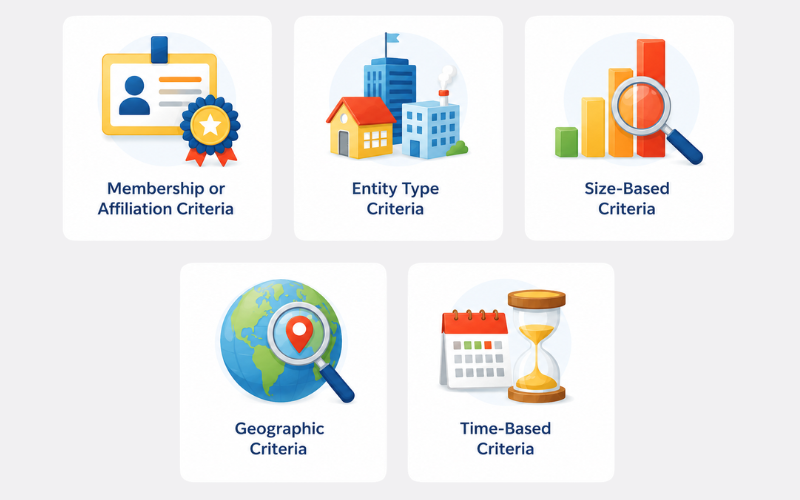
Most eligibility rules fall into several categories. Effective programs combine multiple criteria types to define their competitive field precisely.
Time-based criteria
Defines when the achievement or entity must exist.
Achievement timing: Work must have been completed, launched, or implemented within a specific period.
- “Projects completed between 1 January 2024 and 31 December 2024”
- “Products launched within the 18 months preceding the entry deadline”
Entity age: Organisation must have existed for a minimum or maximum period.
- “Companies founded within the last five years”
- “Organisations operating for at least two years”
Continuous operation: Entity must have been active throughout the eligibility period.
- “Businesses trading continuously for the full eligibility year”
Geographic criteria
Defines where the entrant or achievement must be located.
Headquarters location: Where the organisation is legally based.
- “Companies headquartered in the European Union”
- “Organisations with registered offices in the United States”
Operational presence: Where the organisation actively operates.
- “Businesses with physical operations in the APAC region”
- “Companies with at least 50% of revenue from UK customers”
Achievement location: Where the work being recognised took place.
- “Projects implemented in Latin America”
- “Campaigns targeting the Australian market”
Size-based criteria
Defines the scale of eligible organisations.
Revenue thresholds:
- “Companies with annual revenue under £10 million”
- “Organisations with turnover between €5 million and €50 million”
Employee count:
- “Businesses with fewer than 250 employees”
- “Organisations with 50–500 full-time staff”
Stage-based:
- “Startups that have raised no more than Series A funding”
- “SMEs as defined by [specific definition source]”
Entity type criteria
Defines what kind of organisation can enter.
Legal structure:
- “Registered companies, partnerships, or LLPs”
- “Non-profit organisations with charitable status”
Sector or industry:
- “Licensed financial services providers”
- “Accredited healthcare organisations”
Business model:
- “B2B technology vendors”
- “Direct-to-consumer brands”
Membership or affiliation criteria
Defines required relationships or credentials.
Association membership:
- “Current members of [Association Name] in good standing”
- “Open to members and non-members (different fee structures apply)”
Certifications or accreditations:
- “ISO 27001 certified organisations”
- “Companies with current [industry accreditation]”
Partnership status:
- “Authorised partners of [Platform/Vendor]”
- “Registered suppliers on [Framework/Directory]”
Entry-specific criteria
Defines requirements for the submission itself.
Prior recognition:
- “Work not previously submitted to this program”
- “Entries that have not won equivalent awards elsewhere”
Submission completeness:
- “Entries must include all required supporting materials”
- “Submissions without customer references will not be considered”
Consent and rights:
- “Entrant must have rights to submit all included materials”
- “Customer permission required for case study inclusion”
Exclusion criteria
Defines who explicitly cannot enter.
Conflict exclusions:
- “Employees of the organising body are not eligible”
- “Current judges and their immediate family members may not enter”
Competitive exclusions:
- “Previous winners in this category are ineligible for two years”
- “Finalists from the previous year may not enter the same category”
How to write eligibility rules that are actually clear
Clear eligibility rules share several characteristics.
Vague language invites interpretation. Specific language answers questions.
| Vague | Specific |
|---|---|
| “Small businesses” | “Companies with fewer than 50 employees and annual revenue under £5 million” |
| “Recent work” | “Work completed between 1 March 2024 and 28 February 2025” |
| “UK-based” | “Companies with registered headquarters in England, Scotland, Wales, or Northern Ireland” |
Define your terms
When using industry terminology or categories that might be interpreted differently, provide definitions or reference authoritative sources.
- “SME as defined by the European Commission (fewer than 250 employees, turnover under €50 million)”
- “Startup defined as a company founded within the last five years that has raised no more than Series B funding”
Use measurable criteria where possible
Subjective criteria are difficult to verify and easy to dispute. Where possible, use measurable thresholds.
| Subjective | Measurable |
|---|---|
| “Established companies” | “Companies operating for at least three years” |
| “Significant industry presence” | “Companies with at least £1 million annual revenue from the sector” |
| “Primarily focused on healthcare” | “Companies deriving at least 60% of revenue from healthcare clients” |
Specify the reference date
When criteria involve timing, specify when the measurement applies.
- “Employee count as of the entry deadline”
- “Revenue for the most recent completed financial year”
- “Membership status at time of submission”
Address common edge cases proactively
Anticipate questions and answer them in your criteria.
- “Parent companies and subsidiaries may enter separately if they operate as distinct business units with separate management”
- “Joint ventures are eligible if the entrant has majority operational control”
- “Franchisees may enter independently; franchisor entries should not include franchisee achievements”
Examples: vague vs. clear eligibility statements
Example 1: Company size
Vague:
“Open to small and medium-sized businesses in the technology sector.”
Problems: What defines “small”? What defines “medium”? What counts as “technology sector”?
Clear:
“Open to technology companies meeting the following criteria:
Annual revenue between £500,000 and £25 million (most recent completed financial year)
Fewer than 150 full-time employees (as of entry deadline)
At least 70% of revenue derived from technology products or services”
Example 2: Geographic scope
Vague:
“Open to European companies.”
Problems: Does “European” mean EU only? Does it include UK post-Brexit? What about companies headquartered elsewhere with European operations?
Clear:
“Open to companies meeting one of the following:
Registered headquarters in an EU member state, UK, Switzerland, or Norway
Non-European headquarters but at least 50% of employees based in the above regionsThe work being submitted must have been primarily delivered to customers in these regions.”
Example 3: Achievement timing
Vague:
“Entries should feature recent work.”
Problems: How recent? What if a project started two years ago but completed recently?
Clear:
“Eligible work must have been substantially completed between 1 January 2024 and 31 December 2024. For multi-year projects, the majority of deliverables and measurable outcomes must fall within this period. Projects completed before 2024 are not eligible, even if results were measured in 2024.”
Example 4: Prior recognition
Vague:
“Original work only.”
Problems: Can work that won other awards enter? What about work submitted elsewhere but didn’t win?
Clear:
“Entries must not have won Gold or equivalent top-tier recognition in competing industry awards programs. Work that was entered elsewhere but did not win, or that received lower-tier recognition (Silver, Bronze, Finalist), remains eligible. Previous submissions to this program that did not reach finalist stage may be resubmitted with updated information.”
Example 5: Entity relationships
Vague:
“One entry per company.”
Problems: What about subsidiaries? Divisions? Different brands owned by the same parent?
Clear:
“One entry per category per legal entity. Separate subsidiaries with distinct company registration numbers may enter independently. Different brands or divisions within the same legal entity must submit a single combined entry or choose their strongest example. Parent company entries should not include achievements primarily delivered by separately-registered subsidiaries.”
Handling edge cases and exceptions
No eligibility rules anticipate every situation. How you handle edge cases affects credibility as much as the rules themselves.
Establish a process before you need it
Define who decides eligibility questions, how quickly decisions will be made, and whether decisions are final. This prevents ad-hoc rulings that might be inconsistent.
Document decisions for consistency
When you rule on an edge case, record the reasoning. Similar situations should receive similar rulings. Inconsistent decisions invite justified complaints.
Communicate proactively
If eligibility questions are common, your rules may need clarification. Update criteria for future cycles rather than repeatedly explaining the same edge cases.
Be transparent about close calls
When entries are borderline, explain your reasoning if asked. “Your 2023 completion date fell two weeks outside our eligibility window” is defensible. Refusing to explain appears arbitrary.
Consider a formal exceptions process
For complex programs, a short exceptions request form allows entrants to explain unusual circumstances. This provides structured information for decisions and signals that you’ll consider legitimate cases fairly.
Default to inclusion when genuinely ambiguous
When rules are unclear and an entrant made a reasonable interpretation, consider accepting the entry and clarifying rules for future cycles. Penalising entrants for your drafting ambiguity damages trust.
Eligibility verification
What can you check?
Eligibility rules only work if they can be enforced. Consider verification feasibility when designing criteria.
Easy to verify
- Company registration: Public records confirm headquarters location, founding date, legal structure
- Membership status: Your own records confirm current membership
- Previous entry/winner status: Your program database tracks prior submissions
- Certification status: Accreditation bodies maintain public registries
Moderate effort to verify
- Revenue and employee count: Requires documentation from entrant (financial statements, HR records); can be verified for public companies via filings
- Achievement timing: Requires supporting evidence (launch dates, project documentation, press coverage)
- Customer references: Requires contacting references to confirm claimed relationships
Difficult to verify
- Percentage-based thresholds: “60% of revenue from healthcare” requires detailed financial breakdown and trust
- Operational control: “Majority control of joint venture” requires legal documentation review
- Subjective judgements: “Primarily focused on innovation” depends on interpretation
Verification approaches
- Self-certification with spot-checks: Entrants confirm eligibility; you verify a random sample or entries that seem questionable.
- Documentation required: Entrants must provide evidence (financial statements, registration documents) for key criteria.
- Third-party verification: For high-stakes criteria (financial data), require accountant confirmation or audited statements.
- Accept and audit finalists: Full eligibility verification only for entries advancing to finalist stage, reducing verification burden while protecting final outcomes.
Common eligibility mistakes
Criteria that sound clear but aren’t
“UK-based companies” seems obvious until someone asks about a company headquartered in Ireland with 80% UK staff. Apparent clarity often hides ambiguity.
Criteria you can’t actually enforce
Rules requiring information you can’t verify or won’t realistically check undermine credibility. Don’t include criteria you’ll ignore.
Criteria that exclude your best potential entrants
Overly restrictive rules might filter out exactly the organisations you want. Test criteria against your ideal entrant profile before publishing.
Criteria that create unfair advantages
Size thresholds at arbitrary points can create situations where a company with £9.9 million revenue competes against one with £2 million. Consider whether your bands create meaningful groupings.
Changing criteria mid-cycle
Altering eligibility after entries open, even to fix obvious problems, invites complaints from entrants who relied on original rules. Fix issues in future cycles, not current ones.
Burying important criteria
Eligibility rules should be prominent and accessible, not hidden in lengthy terms and conditions. If entrants don’t see criteria before starting entries, you’ll face disputes.
Checklist
Eligibility criteria that prevent disputes
Completeness
[ ]Time-based criteria specify exact dates and measurement points
[ ]Geographic criteria define exactly which locations qualify
[ ]Size criteria use measurable thresholds with clear definitions
[ ]Entity type criteria specify which organisation types can enter
[ ]Exclusion criteria explicitly list who cannot enter
Clarity
[ ]All key terms are defined or reference authoritative sources
[ ]Common edge cases are addressed proactively
[ ]Criteria are specific enough that entrants can self-assess accurately
[ ]No criteria rely on subjective interpretation
Enforceability
[ ]All criteria can realistically be verified
[ ]Verification approach is defined for each criterion
[ ]Documentation requirements are clear to entrants
[ ]Process exists for handling edge cases and exceptions
Accessibility
[ ]Eligibility rules are prominent and easy to find
[ ]Rules are published before entry opens
[ ]Contact information provided for eligibility questions
Conclusion
Eligibility is where most awards disputes begin, vague rules invite interpretation, overly complex rules confuse entrants, and rules that seem clear until edge cases emerge create awkward mid-program decisions that damage relationships. Well-designed eligibility criteria prevent these problems by telling potential entrants exactly whether they qualify before they invest time in submissions. Replace vague language with specific, measurable thresholds: “small businesses” becomes “companies with fewer than 50 employees and annual revenue under £5 million.” Define your terms by referencing authoritative sources. Specify reference dates so entrants know when measurements apply. Address common edge cases proactively, parent companies versus subsidiaries, joint ventures, franchisees, prior recognition from other programs.
And critically, only include criteria you can actually verify. Rules requiring information you can’t check undermine credibility, so match your criteria to your verification capacity: self-certification with spot-checks for low-risk criteria, documentation requirements for key thresholds, and full verification reserved for finalists if resources are limited.
When edge cases arise, and they will, how you handle them affects credibility as much as the rules themselves. Establish a process before you need it: define who decides eligibility questions, document decisions for consistency so similar situations receive similar rulings, and be transparent about close calls when entrants ask. Default to inclusion when rules are genuinely ambiguous, because penalising entrants for your drafting problems damages trust. Avoid the common mistakes: criteria that sound clear but hide ambiguity, criteria that exclude your best potential entrants, arbitrary size thresholds that create unfair groupings within bands, and changing criteria mid-cycle even to fix obvious problems.
Make eligibility rules prominent and accessible, not buried in terms and conditions, and publish them before entries open. The goal is criteria specific enough that entrants can self-assess accurately, judges can focus on quality rather than eligibility debates, and you never have to disqualify an entry that made a reasonable interpretation of unclear rules.
→ How to Define Award Categories That Actually Work : Categories define what you recognise; eligibility defines who can compete. These decisions work together to create clear boundaries and fair competition.
→ How to Write Judging Criteria That Judges Can Actually Use : Once eligibility is clear, judging criteria determine how entries are evaluated. Both need the same specificity and clarity.
→ Why Most Industry Awards Lose Credibility : Eligibility disputes are one way programs lose trust. This guide covers the full range of credibility failures and how to avoid them.
→ How to Design a Credible Awards Program : The complete guide to awards program structure, where eligibility fits alongside category design, judging models, and timeline planning.
Frequently Asked Questions
Eligibility rules are where interpretation meets enforcement. When criteria are vague or incomplete, entrants make reasonable assumptions about whether they qualify. If those assumptions are later challenged, especially after submission or shortlisting, disputes arise regardless of the organiser’s intent.
Clear, specific, and measurable eligibility criteria prevent this friction by allowing entrants to self-assess accurately before investing time in their submission, reducing the likelihood of mid-program disqualifications.
A rule is truly clear when it uses specific, measurable thresholds and defines key terms. Phrases like “small business,” “recent work,” or “UK-based” seem obvious but often hide ambiguity.
Clear rules specify:
- Exact revenue or employee thresholds
- Precise eligibility dates (with reference points)
- Defined geographic scope (which countries or regions count)
- Authoritative definitions where relevant (e.g., SME as defined by a named body)
If an entrant still needs to email for clarification, the rule likely needs refinement.
Time-based criteria should include exact dates and clarify what qualifies within that window. For example, instead of “recent projects,” specify “projects substantially completed between 1 January 2024 and 31 December 2024.”
For multi-year initiatives, define how they qualify (e.g., majority of deliverables or measurable outcomes must fall within the eligibility period). Always state the reference point, such as “as of the entry deadline” or “most recent completed financial year.”
Ambiguity around legal entities frequently causes disputes. Effective rules clarify whether entries are allowed per legal entity, per brand, or per parent group.
For example:
- Separate subsidiaries with distinct registration numbers may enter independently.
- Divisions within the same legal entity must submit a single combined entry.
- Parent companies may not claim achievements primarily delivered by separately registered subsidiaries.
Defining these boundaries upfront prevents inconsistent treatment later.
Not necessarily. Verification should match risk and resources. Common approaches include:
- Self-certification with spot checks for lower-risk criteria
- Documentation requirements for revenue, employee count, or project timing
- Full verification for finalists only, reducing operational burden while protecting final outcomes
The key principle is enforceability: only include eligibility criteria you can realistically verify.
Edge cases are inevitable. Before entries open, define who has authority to interpret eligibility questions and whether decisions are final. Document rulings so similar cases receive consistent treatment.
If rules are genuinely ambiguous and an entrant made a reasonable interpretation, defaulting to inclusion for that cycle, while clarifying rules for the future, often protects trust more effectively than strict exclusion.
Frequent mistakes include:
- Criteria that appear clear but lack precise definitions
- Subjective requirements that are difficult to verify
- Arbitrary size bands that group incomparable organisations
- Changing eligibility rules after entries open
- Burying key criteria in long terms and conditions
Each of these increases the likelihood of disputes and undermines perceived fairness.
When eligibility is verified before judging begins, judges can focus entirely on evaluating quality rather than debating whether an entry belongs in the category. This improves scoring consistency and protects the integrity of outcomes.
Clear eligibility also signals professionalism. Specific, enforceable criteria demonstrate that the program is thoughtfully structured rather than casually managed, which increases trust among entrants, judges, and observers alike.