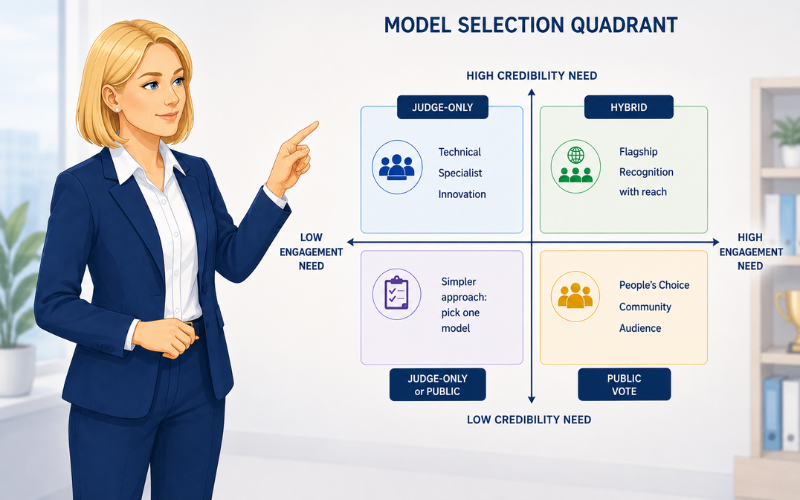
The judging model you choose affects far more than the evaluation process. It shapes perception, participation, and outcomes in ways that compound over time.
It determines what entrants optimise for.
When experts judge, entrants focus on substance, evidence, and meeting evaluation criteria. When public voting decides, entrants focus on reach, visibility, and mobilising supporters. These are fundamentally different behaviours that produce fundamentally different submissions.
It affects who enters.
Strong performers with limited public profiles thrive in judge-led programs where quality speaks for itself. Well-known brands with large audiences have inherent advantages in public voting. Your judging model influences which organisations see your awards as worth pursuing.
It defines what winning means.
Judge-selected winners carry the weight of expert validation. “Independent experts evaluated the field and determined this was best.” Public vote winners carry the weight of popular support. “The community chose this as their favourite.” These are different statements, and both are legitimate, but they’re not interchangeable.
It shapes long-term credibility.
Programs known for rigorous expert evaluation build reputations as arbiters of quality. Programs known for engaged public voting build reputations as community celebrations. Programs with unclear or inconsistent approaches build reputations for neither.
Choosing a judging model isn’t an administrative detail. It’s a strategic decision about what your awards mean and who they serve.
Judge-only awards: expert evaluation
In judge-only programs, independent experts evaluate entries and determine winners. There is no public voting component, outcomes rest entirely on judge assessment.
How it works
Entries are assigned to qualified judges with relevant expertise. Judges evaluate submissions against defined criteria, typically using scoring rubrics that assess specific dimensions of quality. Scores are aggregated across multiple judges, and highest-scoring entries win.
The process may include multiple rounds, initial screening to identify finalists, then detailed evaluation to select winners. Some programs use consensus discussion among judges; others rely purely on independent scoring.
Strengths
Credibility through expertise.
Winners are selected by people qualified to evaluate quality. This carries weight with buyers, partners, and industry observers who trust expert judgement over popularity.
Focus on substance.
Entrants compete on merit rather than marketing reach. Strong work from lesser-known organisations can win against well-known competitors because judges evaluate what’s submitted, not who submitted it.
Consistent evaluation.
Structured criteria and trained judges produce more consistent assessment than public voting, where individual voters apply their own undefined standards.
Protection from manipulation.
Judge panels are harder to game than public votes. Coordinated campaigns, fake accounts, and vote-buying don’t affect outcomes.
Weaknesses
Limited engagement.
Judge-only programs don’t generate the audience participation and viral sharing that public voting creates. Recognition happens in a closed process, announced only when complete.
Judge quality dependency.
Outcomes are only as good as judges. Poorly selected panels, inadequate briefing, or conflicts of interest undermine credibility quickly.
Perception of opacity.
Without visible public participation, some audiences question whether judging was truly fair. Transparency about process and judges helps, but scepticism persists in some contexts.
Resource intensive.
Recruiting qualified judges, managing conflicts, coordinating evaluation, and ensuring consistency requires significant operational effort.
Best For
- Technical or specialist categories requiring deep expertise
- Awards where third-party validation matters more than engagement
- Programs targeting B2B audiences who value expert endorsement
- Categories assessing quality, innovation, or performance against objective criteria
- Situations where manipulation risk is high or perception of fairness is critical
Public voting awards: audience-decided recognition
In public voting programs, audiences vote for their preferred entries, and vote counts determine winners. There is no expert evaluation, outcomes reflect collective preference.
How it works
Entries are made visible to voters, typically through a public gallery or ballot. Voters select their favourites, either choosing one winner per category or ranking multiple options. Votes are counted over a defined period, and entries with the most votes win.
Programs vary in voter eligibility (anyone, registered users, verified accounts), vote limits (one vote total, one per category, daily voting), and verification methods (email confirmation, account login, CAPTCHA).
Strengths
High engagement. Public voting transforms passive audiences into active participants. Entrants promote their nominations, voters share their choices, and the awards become community events rather than closed evaluations.
Reach and visibility.Voting campaigns drive traffic, social sharing, and conversation. Programs gain exposure far beyond what announcement-only approaches achieve.
Democratic legitimacy. Winners can claim genuine popular support. “Chosen by 10,000 voters” carries a different kind of authority than expert selection, not better or worse, but different.
Operational simplicity.Counting votes is simpler than coordinating judge panels, managing conflicts, and aggregating subjective scores. The process is transparent and easily understood.
Weaknesses
Popularity over quality. Large, well-known entrants with existing audiences have structural advantages unrelated to achievement quality. Smaller organisations doing excellent work may never compete effectively.
Manipulation vulnerability.Vote buying, fake accounts, coordinated campaigns, and social pressure can distort outcomes. Even when manipulation doesn’t occur, the possibility undermines trust.
Inconsistent standards. Each voter applies their own criteria. Some vote on quality, others on familiarity, others on personal relationships. Aggregated votes don’t reflect coherent evaluation.
Category mismatch. Public voting works poorly for categories requiring specialist knowledge to evaluate. Asking general audiences to judge technical innovation or operational excellence produces questionable results.
Best for
- People’s Choice or Audience Favourite categories explicitly measuring popularity
- Community-driven awards where participation matters as much as outcomes
- Programs prioritising engagement and reach over evaluation rigour
- Categories where broad appeal is a legitimate success measure
- Audiences who distrust expert gatekeeping and prefer democratic selection
Hybrid models: combining expert and public input
Hybrid programs incorporate both expert judgement and public voting, combining them in various ways to balance credibility with engagement.
How it works
Hybrid structures vary significantly. Common approaches include:
Weighted combination. Judges and public votes each contribute a percentage to final scores. A 70/30 judge/public split means expert evaluation dominates while public input influences outcomes. A 50/50 split treats both equally.
Sequential filtering. Judges evaluate all entries and select finalists. Public voting then determines winners from among the shortlisted options. This ensures baseline quality while giving audiences final say.
Parallel tracks. Judges determine official winners while public voting determines a separate People’s Choice award. Both recognitions exist independently without influencing each other.
Tiered categories. Some categories use judge-only evaluation (technical awards, innovation categories) while others use public voting (community favourites, audience choice). The program includes both models for different purposes.
Weighting Decisions
When judges and public votes combine mathematically, weighting choices matter:
| Weighting | Signal |
|---|---|
| 80/20 judge/public | Expert credibility primary; public adds engagement without determining outcomes |
| 70/30 judge/public | Strong expert foundation with meaningful public influence |
| 50/50 judge/public | Both perspectives valued equally; neither dominates |
| 30/70 judge/public | Public preference primary; judges provide quality filter |
Higher judge weighting strengthens credibility claims. Higher public weighting strengthens engagement and democratic legitimacy. There’s no universally correct balance, it depends on what you want winning to mean.
Sequencing decisions
When hybrid models use sequential phases, order matters:
Judge-first models (judges shortlist, public votes on finalists) ensure every option voters see has passed expert quality review. This protects against unworthy winners while enabling audience participation in final selection.
Public-first models (public nominates, judges select winners) surface popular options that experts then evaluate. This prevents expert panels from overlooking crowd favourites while maintaining final quality control.
Strengths
Balanced positioning. Hybrid programs can claim both expert validation and community support, appealing to audiences who value either.
Flexible design. Different categories can use different approaches based on what makes sense for each type of recognition.
Engagement with guardrails. Public participation drives visibility without fully determining outcomes in ways that might undermine credibility.
Weaknesses
Complexity. Hybrid rules require clear communication. When participants don’t understand how judges and votes combine, confusion replaces confidence.
Diluted claims. Programs can’t fully claim expert credibility (public votes influenced outcomes) or democratic legitimacy (judges overrode popular preference). The positioning is “both” but also “neither fully.”
Operational overhead. Running both judging and voting requires infrastructure, coordination, and communication for two separate processes.
Best for
- Programs wanting engagement without sacrificing credibility entirely
- Awards where both expert assessment and community voice legitimately matter
- Organisations testing public voting before committing fully
- Programs with diverse categories where different models suit different awards
How to choose the right model
No model is universally superior. The right choice depends on your specific context.
Start with purpose
What do you want winning to signify?
- “Independent experts identified this as best” → Judge-only
- “The community chose this as their favourite” → Public voting
- “Experts validated quality and the community confirmed appeal” → Hybrid
If you can’t articulate what winning means, you can’t choose the right model.
Consider your audience
Who are you trying to reach, and what do they value?
- B2B buyers seeking vendor validation typically trust expert judgement
- Consumer audiences may prefer democratic, participatory approaches
- Professional communities often value peer recognition over external evaluation
- General public engagement favours visible, shareable voting
Assess manipulation risk
How vulnerable is your program to gaming?
- High-profile awards with commercial stakes attract manipulation attempts
- Engaged communities with shared values may self-police effectively
- Technical categories with specialist audiences face lower manipulation risk
- Consumer-facing categories with broad voting pools are most vulnerable
Evaluate your resources
What can you actually execute well?
- Judge-only requires recruiting qualified experts, managing conflicts, ensuring consistency
- Public voting requires fraud prevention, promotion infrastructure, results management
- Hybrid requires both, don’t underestimate the operational overhead
Match model to category
Different categories within the same program can use different models:
- Technical innovation → Judge-only
- Customer favourite → Public voting
- Best overall company → Hybrid
Consistency within categories matters more than uniformity across the program.
Can you change models later?
Programs can evolve their judging models, but changes require careful management.
When changing makes sense
- Current model produces outcomes that don’t reflect program purpose
- Audience expectations have shifted
- Operational capacity has changed
- Credibility concerns have emerged with existing approach
Risks of changing
- Confuses participants expecting continuity
- May alienate past winners whose recognition came under different standards
- Creates comparison problems across program years
- Signals uncertainty about program identity
How to change well
- Announce changes well before implementation
- Explain the reasoning honestly
- Consider transitional approaches (phased weighting shifts rather than abrupt model changes)
- Acknowledge that past and future winners achieved recognition under different systems
Evolution is healthy. Erratic changes signal confusion. The difference lies in communication and consistency.
Emerging models: data-driven and algorithmic awards
Beyond judge-led, public-voted, and hybrid approaches, some programs experiment with data-driven or algorithmic evaluation.
These models use proprietary datasets, performance metrics, or algorithmic analysis to determine winners, reducing or eliminating human judgement and public voting entirely. Winners are identified through data rather than decided through evaluation.
Examples include:
- Awards based on verified performance metrics (customer satisfaction scores, growth rates, operational benchmarks)
- Recognition derived from algorithmic analysis of market data, search trends, or competitive intelligence
- Programs where proprietary data infrastructure enables claims verification that traditional judging cannot match
Why most programs don’t use these models:
Data-driven awards require infrastructure most organisations don’t have, proprietary datasets, verification mechanisms, and analytical capabilities that take years and significant investment to build. They also raise questions about methodology transparency and whether algorithms can capture excellence dimensions that resist quantification.
For most awards programs, the choice remains among judge-only, public voting, and hybrid approaches. Data-driven models represent a specialised niche rather than a mainstream alternative.
Model comparison summary
| Dimension | Judge Only | Public Voting | Hybrid |
|---|---|---|---|
| Who decides | Expert panel | Audience votes | Both contribute |
| Credibility source | Expert validation | Popular support | Balanced positioning |
| Engagement level | Lower | Higher | Medium |
| Manipulation risk | Lower | Higher | Depends on weighting |
| Operational complexity | High (judge management) | Medium (fraud prevention) | Highest (both) |
| Best for | Technical, specialist, B2B | Community, consumer, engagement | Balanced, diverse programs |
| Winning means | “Experts chose best” | “Audience chose favourite” | “Validated and supported” |
Conclusion
The judging model you choose is a strategic decision that shapes everything downstream, what entrants optimise for, who sees your awards as worth pursuing, what winning actually signifies, and the long-term credibility you build. Judge-only models produce expert validation where winners are selected by people qualified to evaluate quality, protecting against manipulation and ensuring substance wins over marketing reach, but they sacrifice the engagement and visibility that public voting generates.
Public voting creates community participation and democratic legitimacy where “chosen by 10,000 voters” carries real weight, but it advantages well-known brands over quality performers, invites manipulation concerns, and produces outcomes where each voter applies their own undefined standards. Hybrid models attempt balance through weighted combinations, sequential filtering, or parallel tracks, but they’re operationally complex and risk diluting both credibility claims and engagement benefits if the weighting rationale isn’t clear.
Start with purpose: write down what winning should mean in a single sentence, and let that guide your model choice. “Independent experts identified this as best” points toward judge-only. “The community chose this as their favourite” points toward public voting. “Experts validated quality and the community confirmed appeal” points toward hybrid, but with weighting that reflects which dimension matters more. Consider your audience and what they trust, assess how vulnerable your categories are to gaming, and honestly evaluate what you can execute well.
Different categories within the same program can use different models, technical innovation categories benefit from expert evaluation while audience favourite categories belong with public voting. Data-driven approaches using proprietary datasets and algorithmic analysis represent an emerging alternative, but they require infrastructure most organisations don’t have. Whatever model you choose, consistency within categories matters more than uniformity across the program, and if you need to change models later, announce changes early and explain the reasoning honestly.
→ How to Choose the Right Judging Model for Your Awards : A decision framework that walks through purpose, audience, manipulation risk, and operational capacity to help you select the right approach.
→ Public Voting in Awards: When It Works, When It Backfires : Deeper guidance on public voting specifically, including safeguards, fraud prevention, and when it strengthens versus undermines credibility.
→ Data-Driven Awards & Evidence-Based Judging : Explore emerging models that use proprietary data and algorithmic evaluation to identify winners.
→ How to Design a Credible Awards Program : The complete guide to awards program structure, where judging model choice fits alongside category design, eligibility rules, and timeline planning.
Frequently Asked Questions
The judging model determines what entrants optimise for. In judge-only programs, entrants focus on evidence, measurable outcomes, and aligning tightly with evaluation criteria because experts will scrutinise substance. In public voting programs, entrants prioritise visibility, audience mobilisation, and campaign reach, since vote volume determines success.
These behavioural shifts compound over time. The model you choose doesn’t just affect how winners are selected, it shapes the type and quality of submissions you receive year after year.
A judge-only model is strongest when expertise and technical evaluation matter most. It works particularly well for specialist, innovation, performance, or B2B categories where credibility depends on informed assessment rather than popularity.
Because independent experts apply defined criteria, outcomes carry the weight of professional validation. This model is also less vulnerable to manipulation and better suited to situations where fairness and defensibility are critical.
Public voting awards prioritise engagement and visibility, but they carry structural risks. Well-known brands with large audiences have built-in advantages unrelated to quality, and smaller but high-performing entrants may struggle to compete.
Public voting is also more vulnerable to manipulation through fake accounts, coordinated campaigns, or vote-buying. Even when safeguards exist, the perception of gaming can undermine trust if categories require specialist knowledge that general voters may not have.
Hybrid models combine expert evaluation and public voting, either through weighted scoring, sequential shortlisting, parallel awards (official winner and People’s Choice), or category-based splits. This allows programs to claim both expert validation and community participation.
However, clarity is essential. If weightings, sequencing, or influence are not clearly defined upfront, confusion replaces confidence. A hybrid model only strengthens credibility when participants understand exactly how final outcomes are determined.
Weighting determines what winning signifies. An 80/20 or 70/30 judge-to-public split signals that expert credibility is primary, with public input adding engagement. A 50/50 split signals equal value placed on professional assessment and audience preference. A 30/70 split signals popularity as the dominant factor.
There is no universally correct balance. The right weighting depends on whether you want winners to be known primarily for expert endorsement, community support, or a deliberate blend of both.
Yes, and in many cases, they should. Technical innovation categories may require judge-only evaluation, while “Customer Favourite” or community awards are well suited to public voting. Broader “Best Overall” categories might use hybrid approaches.
Consistency within each category matters more than uniformity across the entire program. Each model should clearly align with what that specific category is designed to recognise.
Before deciding, assess:
- What winning is meant to signal (expert validation, popular support, or both)
- Who your audience is and what they value
- The level of manipulation risk in your sector
- The operational resources you can realistically manage
- Whether the category requires specialist knowledge to evaluate fairly
The judging model is a strategic positioning decision, not an administrative one. It defines what your awards stand for.
Changing models can be healthy when the current approach no longer reflects your purpose or audience expectations. However, abrupt or poorly explained changes can confuse entrants, alienate past winners, and create inconsistencies across years.
If change is necessary, communicate it early, explain the reasoning transparently, and consider phased transitions rather than sudden shifts.
Data-driven awards rely on verified performance metrics, proprietary datasets, or algorithmic analysis to determine winners without traditional judging or voting. While they can reduce subjectivity, they require significant infrastructure and raise transparency questions about methodology.
For most programs, the practical choice remains between judge-only, public voting, or hybrid models. Data-driven approaches are specialised and viable only when robust, credible data systems already exist.