Most awards programs launch too late, and not late in the sense of a missed deadline, but late in the sense that there simply wasn’t enough runway between deciding to run the thing and opening for entries. Categories get finalised while the entry form is still being built, judges get recruited after the submissions have started arriving, and the marketing happens in two compressed bursts instead of as a sustained campaign.
What follows is preventable chaos, compromised quality, and a first year that sets exactly the wrong foundation for everything after it. A well-timed launch isn’t complicated, on the other hand, it just needs more runway than most organisers expect, because what looks from the outside like three simple steps (define categories, collect entries, pick winners) is really dozens of interlocking decisions, most of which can’t start until something else has finished.
This guide gives you a realistic timeline from initial planning through to post-program wrap-up, and whether you’re launching something new or tidying up a programme you’ve run for years, the sequencing matters as much as the individual tasks do.
On this page
- What to decide before you set any dates
- The shape of the whole cycle
- Phase 1: foundation
- Phase 2: pre-launch
- Phase 3: call for entries
- Phase 4: judging
- Phase 5: announcement and celebration
- Phase 6: post-program
- Adjusting the timeline to your program
- What always takes longer than you think
- The launch checklist
What to decide before you set any dates
A timeline built on unsettled strategy is just a list of activities that will need rescheduling, so five things want confirming before you put a single date in a calendar.
Purpose and positioning. What does this program exist to achieve — brand building, member engagement, revenue, industry authority? Your answer shapes everything downstream, from how you design categories to how much you spend promoting them, and without clarity here you’ll make decisions in month four that contradict decisions you made in month one.
Target audience. Who are you trying to attract as entrants, and who should care that somebody won? That determines your category design, where you promote, and what winning is actually worth.
Judging model. Will experts evaluate the entries, will the public vote, or will you run some combination of the two? This has a bigger effect on your timeline than almost anything else, because expert judge recruitment takes months whereas public voting needs entirely different infrastructure preparing.
Budget reality. What resources do you actually have? A six-figure program with dedicated staff and a volunteer-led initiative running on goodwill are both perfectly viable, but they are not the same program on different budgets, and the timeline has to match what you can genuinely resource.
Fixed dates. Are there immovable constraints, such as an annual conference where the winners have to be announced, industry events to align with or steer clear of, or a budget cycle that dictates when money becomes available?
The shape of the whole cycle
A standard program runs roughly six to nine months from the start of planning to the winner announcement. You can compress that, though every week you take out is a week of buffer you no longer have, and extending it generally produces a more thorough job.
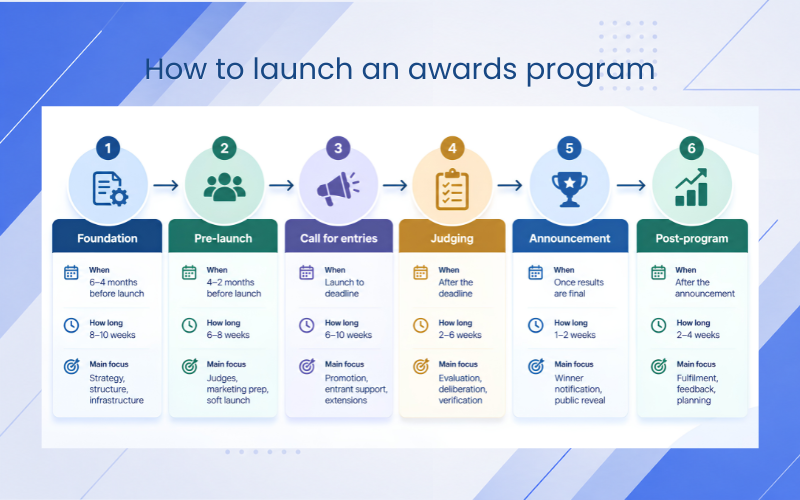
| Phase | When | How long | Main focus |
|---|---|---|---|
| Foundation | 6–4 months before launch | 8–10 weeks | Strategy, structure, infrastructure |
| Pre-launch | 4–2 months before launch | 6–8 weeks | Judges, marketing prep, soft launch |
| Call for entries | Launch to deadline | 6–10 weeks | Promotion, entrant support, extensions |
| Judging | After the deadline | 2–6 weeks | Evaluation, deliberation, verification |
| Announcement | Once results are final | 1–2 weeks | Winner notification, public reveal |
| Post-program | After the announcement | 2–4 weeks | Fulfilment, feedback, planning |
These phases overlap in practice, because judge recruitment often runs into the entry period and marketing intensifies right up to the deadline, but the centre of gravity shifts through the cycle in a fairly predictable way.
Phase 1: foundation (6–4 months before launch)
Everything else gets built on this phase, so anything you rush here will follow you around for the rest of the cycle and, in most cases, into the next one.
Strategic framework (weeks 1–3)
- Define your categories. What specific achievements are you recognising, how do the categories relate to one another, and what makes each one distinct and evaluable? Use the outcome-first approach: for each category, write down what a worthy winner would have accomplished and what evidence would demonstrate it, because any category that can’t survive that test needs rethinking now rather than in month five.
- Establish eligibility rules. Who can enter each category, and on what basis, geographic scope, company size, the time period covered, entity type? Define all of it precisely, since vague eligibility is where disputes come from.
- Determine your judging approach. If you’re using expert judges, how many sit on each category and what expertise do they need? If there’s a public vote, what’s its weighting, and how will a hybrid model actually calculate a result?
- Set your pricing. Entry fees, early bird discounts, member rates, multi-entry packages. Pricing communicates positioning whether you intend it to or not, so make sure it lines up with the prestige you’re claiming and with what your audience expects to pay.
Infrastructure (weeks 3–6)
- Select and configure your platform. Whether you’re using dedicated awards software or adapting general tools, there’s configuration to do on entry forms, judging interfaces, payment processing and any voting mechanism.
- Build the entry forms. Design them around your judging criteria, make sure each question elicits something judges actually need, and test the full submission flow before anyone real touches it.
- Create the program collateral. Website pages or a microsite, category descriptions, eligibility documentation, an FAQ, and terms and conditions, with legal review where that’s needed.
- Establish the brand identity. Naming, visual identity, and trophy or badge design if you’re producing them. A first-year program is creating all of this from nothing, whereas an established one is deciding whether it needs a refresh.
Operational setup (weeks 5–8)
- Assign roles. Who manages entries, who coordinates the judges, who runs marketing, and who resolves a dispute when one lands? Clear ownership is what stops things falling between people.
- Write your communication templates. Entry confirmations, judge briefing documents, winner notifications and the messages to unsuccessful entrants. Drafting these now is what prevents the rushed, inconsistent versions you’d otherwise write at midnight in week nine.
- Set up metrics and reporting. Decide what you’re measuring, entry volume by category, completion rates, judge participation, website traffic, and get the tracking in place before launch, because you can’t backfill it afterwards.
Milestone: a complete category structure, a configured platform, draft entry forms and a clear operational plan. You could technically open, but you have nothing to promote with yet.
Phase 2: pre-launch (4–2 months before launch)
This phase is about readiness: getting judges signed up, getting the marketing built, and starting to build awareness before entries formally open.
Judge recruitment (weeks 1–4)
- Identify your targets. Draw up a wishlist of qualified people whose involvement would strengthen the program’s credibility, and look across practitioners, academics, consultants, analysts and respected industry figures rather than only at the obvious names.
- Start the outreach early. This takes longer than anybody expects, because the people you want are busy, they need to check for conflicts, and they’ll want time to think about it, so start before it feels necessary and follow up more than once.
- Confirm and brief. Everyone who says yes needs onboarding, the timeline, what’s expected of them, the conflict policy, the criteria and their platform access, and you shouldn’t assume any of it is obvious.
- Plan for gaps. Some of the people you want won’t be available, so identify backup candidates for each area of expertise before you need them.
Marketing preparation (weeks 2–6)
- Develop the campaign assets. Launch announcements, email sequences, social content and any advertising creative, mapped onto a content calendar so you know what publishes when.
- Build promotional partnerships. Media partners, industry associations and complementary organisations who might promote you to their audiences all take time to line up, so don’t leave this until launch week.
- Prepare your PR materials. Draft press releases, a media contact list, talking points and a briefed spokesperson, because if you want coverage the materials have to exist before the news does.
- Create entrant resources. Entry guides, tips, example submissions if you have any you can share, and an FAQ. Anything that helps people understand what’s expected raises the quality of what you get back.
Soft launch (weeks 4–6)
- Announce that the program exists. Before entries formally open, build some awareness with a “coming soon” announcement, save-the-date communications, or early access for past participants and members.
- Test everything end to end. Submit a test entry, process a test payment, check the confirmation emails arrive and confirm judges can get into the system, so that you find the problems rather than your entrants finding them.
- Gather early feedback. Share the draft materials with a few trusted contacts and ask whether the form makes sense, whether the categories are clear and whether the pricing feels right, then adjust while adjusting is still cheap.
Milestone: judges confirmed and briefed, marketing ready to execute, systems fully tested. You’re ready to open.
Phase 3: call for entries (launch to deadline)
This is the phase where the program becomes visible, and both the volume and the quality of what arrives depend on how hard you promote and how well you support the people trying to enter.
Launch week
- Execute the launch communications. Email announcements, social posts, press release distribution and partner promotion, all concentrated together so they build momentum rather than trickling out.
- Watch the first entries closely. Early submissions tell you whether the process works as intended, so look for confusion, technical problems and any question that suggests something isn’t explained clearly enough.
- Reply quickly. Early entrants tend to have questions, and a fast, helpful answer both gets that entry completed and generates goodwill that travels by word of mouth.
Sustained promotion (weeks 2–6)
- Keep the visibility up. An entry period usually runs six to ten weeks, which needs ongoing content rather than a burst of launch-week intensity followed by silence.
- Vary the message. Different angles land with different people at different points, so rotate between the credibility of your judging panel, the success of past winners, deadline urgency and promotion aimed at specific categories.
- Track and adjust. Monitor entry rates category by category, push harder on the ones lagging behind, and if the overall volume is disappointing, decide early whether you’re extending the deadline or changing the approach.
- Support the entrants. Answer questions promptly, offer guidance on what makes a strong submission, and consider a webinar or a Q&A session if your program is a complex one.
Deadline management (final two weeks)
- Turn up the urgency. Final-week reminders drive a genuinely significant share of total entries, so countdown messaging, last-chance emails and absolute clarity about the closing time all matter here.
- Decide about extensions in advance. Work out beforehand whether you’ll extend and on what grounds, because an extension announced at the last minute looks disorganised whereas a planned one can be a deliberate part of the campaign.
- Have a policy for late requests. Somebody will miss the deadline and ask for an exception, and you want to have decided your answer before the email arrives rather than in the moment.
Milestone: all entries received, payments processed, completeness review under way, and judging preparation already in motion.
Phase 4: judging (2–6 weeks after the deadline)
Judging is where credibility is either built or lost, and the difference usually comes down to whether the phase was given enough time to be done properly.
Preparation (week 1)
- Finalise the entry assignments. Allocate entries by expertise while working around declared conflicts, and check that the workload is balanced across the panel rather than concentrated on your two most enthusiastic judges.
- Re-brief everyone. Remind judges of the timeline, the criteria and the process, and give them access to their assigned entries with clear instructions, because the briefing you gave them two months ago has faded.
- Run a calibration session. On larger programs, have judges score one or two sample entries together and discuss the results, so that the panel is aligned on standards before independent scoring starts.
Active evaluation (weeks 2–4)
- Monitor progress. Track who has finished and follow up with anyone falling behind, and build in buffer, because somebody always will.
- Answer questions fast. Judges will have queries about specific entries or how to interpret a criterion, and a slow reply turns into a stalled panel.
- Manage late conflicts. Occasionally a conflict surfaces once judging is under way, so have a reassignment process ready rather than improvising one.
Deliberation and verification (weeks 4–6)
- Review the results. Aggregate the scores, identify the winners and look for anomalies, asking whether the outcomes make sense and whether any scoring pattern suggests bias or a miscalibrated judge.
- Verify what you can. For finalists and winners, check key claims where it’s feasible, contact references, compare submissions against public information, and confirm eligibility.
- Handle ties and near-ties. Define your tiebreaker procedure before you need it, since a close result may need further deliberation or a senior judge’s input, and you don’t want to be inventing the rule with the answer already visible.
- Document everything. Record the outcomes, score summaries and deliberation notes, because that documentation is what protects you in a dispute and what improves the program next year.
Milestone: winners confirmed, verified and documented. You’re ready to announce.
Phase 5: announcement and celebration
This is your highest-visibility moment, and how you handle it shapes how people remember the whole program.
Winner notification (a week before the public reveal)
- Tell winners personally. A phone call or a personal email ahead of the public announcement, because nobody should find out they’ve won from a social media post.
- Give them guidance. What can they share before the reveal, what materials will they receive, and exactly when and how does the public announcement happen?
- Collect what you need from them. Quotes for the press release, headshots for the promotional materials, and their availability for interviews or the ceremony.
Public announcement
- Execute the reveal. Whether that’s staged announcements, a single drop, a live ceremony or a publication feature, run the plan you built back in pre-launch.
- Distribute the press materials. Releases, media alerts and winner profiles to industry publications and the journalists on your list.
- Make it easy for winners to promote themselves. Badges, graphics, social assets and suggested wording, since every winner who posts about it is promoting your program too.
- Thank everybody. Entrants, judges, sponsors and partners all deserve acknowledgement, and being gracious about the wider community is what makes people willing to come back next year.
Milestone: announcement complete, winner materials distributed, initial coverage secured. The visible cycle is finished.
Phase 6: post-program (the phase everyone forgets)
Most programs treat the announcement as the finish line, whereas the ones that get better each year treat it as the point where the next cycle starts, and what happens in these few weeks is what determines whether year two is easier than year one.
Fulfilment (weeks 1–2)
- Deliver what you promised. Trophies, certificates, badge files and anything else, because a delay here quietly undermines both winner satisfaction and your credibility.
- Recognise your judges. Thank them formally, provide any compensation or recognition you committed to, and ask them how the experience was while it’s still fresh.
- Archive everything. Entries, scores, communications and decisions all go into storage, since that archive is what resolves a dispute in eight months’ time and what informs your improvements next year.
Feedback and learning (weeks 2–4)
- Survey the participants. Ask entrants, winners and non-winners both, as well as judges, sponsors and your own team what worked, what didn’t and what should change.
- Run an internal retrospective. What would you do differently, where did the timeline slip, and which processes need rebuilding? Write it down while people still remember, because in three months nobody will.
- Analyse the numbers. Entry volume against target, completion rates, category performance, marketing effectiveness and judge participation all feed directly into next cycle’s planning.
Future planning (weeks 3–4)
- Capture the improvement ideas. Categories to add, remove or reword, process fixes and timeline adjustments, documented now rather than reconstructed later.
- Start the groundwork for next time. Judge retention conversations, sponsor renewals and date holds for venues, all of which make next year’s foundation phase considerably lighter.
Milestone: feedback collected, retrospective done, improvements documented, next cycle already begun.
Adjusting the timeline to your program
The standard timeline assumes a moderately complex program with expert judging, so it needs adapting to what you’re actually running.
| Program type | Total | What changes |
|---|---|---|
| Simpler programs | 4–6 months | Foundation and pre-launch combined, a shorter 4–6 week entry period, judging in 1–2 weeks, and an announcement without a ceremony |
| Complex programs | 9–12 months | A longer foundation phase, extended recruitment across several expertise areas, multiple judging rounds, event planning folded into the announcement, and a more sophisticated campaign |
| First-year programs | Add 4–6 weeks | Awareness built from zero, credibility established without a track record, judges recruited without existing relationships, and every piece of infrastructure created from scratch |
| Established annual cycles | Some compression possible | Returning judges need less briefing, past entrants know the process, brand awareness already exists, and your templates are already written |
A caution on compressing. Every week you remove is a week of buffer you no longer have, so only compress if you’re genuinely confident in your execution, and if you’re an established program, resist the pull towards ever-tighter timelines, because that’s how quality erodes without anybody noticing which decision caused it.
What always takes longer than you think
Some activities overrun almost every time, so build the buffer in from the start rather than discovering the problem in week six.
- Judge recruitment. Plan for half again as long as you think, because the people you want are busy, they need to check conflicts, and they often don’t reply quickly.
- Platform configuration. Setup and testing always surface something unexpected, so allow for at least two rounds of revision after the initial build.
- Entry form refinement. The first draft is never the final one, and testing with real people reveals confusion, missing fields and unclear instructions that all need another pass.
- Legal and compliance review. If your terms, privacy policy or eligibility rules need legal sign-off, add weeks rather than days for the back and forth.
- Sponsor negotiations. These move slowly, so if sponsorship revenue is load-bearing in your plan, start the conversations months before your own deadlines suggest you need to.
- Content creation. Category descriptions, entry guidance, judge briefs and marketing copy all take far longer to write than they take to list in a plan.
- Stakeholder alignment. Internal approvals, committee decisions and leadership sign-offs introduce delay at every single phase.
The pattern underneath all seven is the same: anything that depends on other people’s calendars, decisions or feedback takes longer than anything you can complete on your own.
The launch checklist
The full launch checklist, phase by phase
Foundation (6–4 months before)
- Purpose and positioning confirmed
- Categories defined with clear criteria
- Eligibility rules established
- Judging model determined
- Pricing strategy set
- Platform selected and configuration begun
- Entry forms drafted
- Program branding created
- Roles and responsibilities assigned
Pre-launch (4–2 months before)
- Judge recruitment under way
- Marketing campaign planned
- Promotional partnerships secured
- PR materials prepared
- Entrant resources created
- Full system testing completed
- Judges confirmed and briefed
- Soft launch awareness building
Call for entries (launch to deadline)
- Launch communications executed
- Early entries monitored
- Sustained promotion maintained
- Entrant support provided
- Deadline communications sent
- Extension decisions made if needed
Judging (after the deadline)
- Entries assigned to judges
- Judges re-briefed and given access
- Progress monitored and supported
- Results aggregated and reviewed
- Verification completed
- Winners confirmed and documented
Announcement
- Winners notified personally
- Public reveal executed
- Press materials distributed
- Winner assets provided
- Participants thanked
Post-program
- Winner benefits fulfilled
- Judges recognised
- Feedback gathered
- Retrospective conducted
- Metrics analysed
- Next cycle planning begun
Give yourself the runway
Six to nine months sounds like a lot until you start laying the dependencies out, at which point it becomes clear that most of the calendar isn’t yours, it belongs to the judges deciding whether to accept, the lawyer reviewing your terms, and the committee that meets fortnightly.
Build the buffer where the delays actually happen, protect the foundation and judging phases in particular, and treat the post-program weeks as the start of next year rather than the end of this one.
Related guides
- How to define award categories that actually work — category design is a foundation-phase decision that shapes everything downstream, so get it right before you build entry forms.
- How to recruit and brief award judges effectively — where to find judges, how to approach them and what briefing they need.
- How to write award eligibility criteria, with examples — precise eligibility rules prevent disputes, and they belong in the foundation phase.
- How to design a credible awards program — the strategic decisions that come before any timeline planning.
Frequently Asked Questions
Most first-year awards programs feel chaotic because organisers underestimate how much lead time is required between deciding to run a program and opening for entries. Categories are finalised while entry forms are still being built, judges are recruited after submissions arrive, and marketing is compressed into short bursts instead of sustained campaigns.
Without a structured 6–9 month timeline covering strategy, infrastructure, judge recruitment, promotion, judging, and post-program review, interconnected decisions start overlapping in the wrong order. This leads to preventable confusion, lower-quality entries, stressed judges, and a weak foundation for future cycles.
Before setting dates, organisers must clarify five foundational decisions:
- Purpose and positioning (brand building, revenue, member engagement, industry authority)
- Target audience (who should enter and who should value the winners)
- Judging model (expert panel, public vote, or hybrid)
- Budget reality (resources available and staffing capacity)
- Fixed dates or constraints (conferences, industry events, budget cycles)
Without these decisions confirmed, any timeline risks constant revision. Strategic clarity ensures categories, pricing, marketing, and judging processes align from the beginning rather than being adjusted mid-cycle.
A standard awards program typically requires 6–9 months from initial planning to winner announcement. This includes six structured phases: foundation, pre-launch, call for entries, judging, announcement, and post-program wrap-up.
Shorter timelines are possible for smaller or established programs, but compression increases risk. Larger or more complex programs, especially those with multiple judging rounds or live events, may require 9–12 months to execute properly without compromising quality.
The foundation phase, usually 6–4 months before launch, focuses on strategy, structure, and infrastructure. Key activities include:
- Defining categories using an outcome-first approach
- Establishing precise eligibility rules
- Determining the judging model and pricing strategy
- Selecting and configuring the entry platform
- Building entry forms aligned to judging criteria
- Creating branding, templates, and operational roles
By the end of this phase, the core infrastructure should be complete and technically ready to launch, even if marketing has not yet begun.
Judge recruitment consistently takes about 50% longer than organisers anticipate because qualified experts are busy and must check for conflicts of interest before committing. Many require follow-ups before responding.
Recruitment also involves onboarding, briefing on criteria, clarifying expectations, and ensuring balanced expertise across categories. Starting late can delay judging or weaken panel credibility, which directly impacts the perceived authority of the awards.
Most awards programs keep entries open for 6–10 weeks to allow sustained promotion and give entrants time to prepare quality submissions. Launch-week announcements create initial momentum, but consistent visibility throughout the entry window is essential.
Successful entry periods include varied messaging (credibility, deadline urgency, category highlights), responsive entrant support, and targeted promotion to categories with lower volume. Final-week reminders typically drive a significant spike in submissions.
A credible judging phase includes structured preparation, active monitoring, and verification. This involves:
- Assigning entries based on expertise and conflicts
- Re-briefing judges and conducting calibration exercises
- Monitoring evaluation progress
- Aggregating and reviewing scores for anomalies
- Verifying finalist claims where feasible
- Documenting decisions and tie-breaking procedures
Rushing this phase undermines trust. Proper calibration, oversight, and documentation ensure outcomes are defensible and aligned with the program’s stated criteria.
The post-program phase determines whether the awards improve year over year. After announcement, organisers should:
- Deliver promised winner benefits promptly
- Recognise judges and partners
- Gather structured feedback from entrants and stakeholders
- Conduct an internal retrospective
- Analyse entry and marketing metrics
- Document improvements for the next cycle
Treating announcement as the finish line leads to stagnation. Programs that build review and refinement into their timeline strengthen credibility, efficiency, and participant satisfaction in future editions.