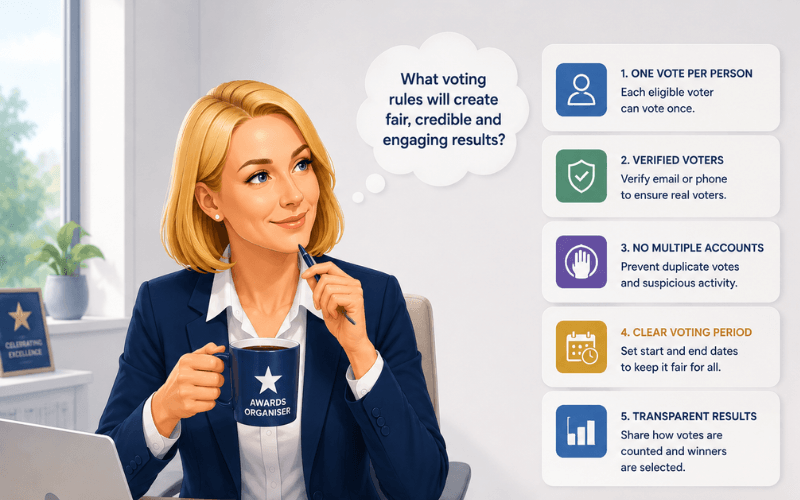
Voting rules exist to ensure outcomes reflect genuine support. But rules that achieve technical fairness can still feel unfair to participants, arbitrary limits that seem to penalise enthusiasm, restrictions that appear to favour certain entrants, or mechanics that confuse rather than clarify.
Perception matters as much as reality. Rules that participants don’t understand, don’t trust, or don’t see as equitable undermine confidence in outcomes regardless of whether the mechanics actually work. Winners face questions about legitimacy. Losers feel cheated by processes they didn’t find credible. The engagement public voting is meant to generate turns into frustration and skepticism.
Fair rules aren’t just technically sound, they’re understandable, consistent, and perceived as equitable by the people subject to them. This guide covers how to design voting rules that achieve both actual and perceived fairness, building trust that makes outcomes meaningful.
Why perception matters
Technical fairness and perceived fairness aren’t the same thing, and both matter.
Technical fairness
Rules are technically fair when they apply equally to all participants, don’t systematically advantage or disadvantage particular entries, and produce outcomes that accurately reflect voter preferences.
A rule limiting one vote per email address is technically fair, everyone faces the same constraint. A rule requiring account verification is technically fair, all voters must meet the same standard.
But technical fairness doesn’t guarantee acceptance. Participants may not understand why rules exist. They may see equal rules as producing unequal effects. They may trust some mechanics and distrust others for reasons unrelated to technical merit.
Perceived fairness
Rules are perceived as fair when participants understand them, believe they’re applied consistently, and feel they have reasonable opportunity to succeed within them.
Perceived fairness requires transparency about what rules are and why they exist. It requires confidence that rules are enforced equally. It requires mechanics that feel reasonable even to those who don’t win.
Programs can have technically fair rules that participants don’t trust, or imperfect rules that participants accept because they understand and believe in them. The goal is both, rules that work and rules that are seen to work.
Core principles for fair voting rules
Several principles underpin rules that achieve both technical and perceived fairness.
Simplicity
Rules participants can’t understand can’t feel fair. Complexity breeds suspicion, if voters don’t understand how their votes count, they may assume the complexity hides something.
Simple rules are easier to follow, easier to enforce, and easier to trust. “One vote per person per entry” is simple. “Votes are weighted by account age, geographic region, and engagement history according to our proprietary algorithm” is not.
When complexity is genuinely necessary, explain it clearly. But first, question whether the complexity is necessary at all.
Consistency
Rules must apply equally to all entries and all voters. Any inconsistency, real or perceived, undermines fairness. If some entrants seem to operate under different rules, trust collapses.
Consistency means the same limits, the same verification requirements, the same mechanics for everyone. It also means consistent enforcement, rules actually applied as stated, not selectively or arbitrarily.
Transparency
Publish rules before voting opens. Explain what rules exist and why. Don’t hide mechanics that participants might find relevant. Transparency enables trust.
Transparency includes explaining enforcement. If votes are removed for rule violations, participants should understand what violations occurred and how they were identified, at least in general terms.
Proportionality
Rules should match their purpose. Heavy restrictions designed to prevent unlikely manipulation frustrate legitimate voters without meaningful benefit. Insufficient restrictions in high-stakes contexts invite the problems they should prevent.
Match rule stringency to actual risk. Community awards with modest stakes don’t need the same safeguards as high-profile industry recognition with commercial implications.
Advance notice
Rules announced after voting begins feel like moving goalposts. Even if changes are well-intentioned, mid-process adjustments invite accusations of manipulation.
Establish rules before voting opens and maintain them throughout. If problems emerge requiring rule changes, apply changes to future cycles rather than retroactively.
Setting vote limits
How many votes each person can cast affects both manipulation resistance and voter experience.
One vote per entry
The simplest and most common approach. Each verified account can vote once for each entry they support. This prevents ballot stuffing while allowing genuine supporters to participate.
Variations include:
- One vote per person across all entries (voter must choose their single favorite)
- One vote per person per category (supporting one entry in each category)
- One vote per person per entry (supporting as many entries as desired, once each)
The last option provides most flexibility for voters and most data for programs but reduces the signal of any individual vote.
Daily voting
Some programs allow one vote per person per entry per day, enabling repeated voting throughout the voting period. This rewards sustained engagement and extended campaign effort.
Daily voting increases total vote counts and extends engagement but may advantage entrants with resources for sustained promotion. It can also feel like it rewards persistence over preference, voting for the same entry daily doesn’t reflect deepening support, just ongoing availability.
If using daily voting, consider whether it serves your purpose or just inflates numbers.
Limited total votes
Some programs give voters a fixed number of votes to allocate across entries, “you have five votes to distribute as you choose.” This forces prioritization and produces more differentiated results.
Limited votes can feel more meaningful , each vote represents a deliberate choice from a constrained allocation. But they’re more complex to communicate and may confuse voters expecting unlimited participation.
No limits
Allowing unlimited voting, vote as many times as you want for as many entries as you want, maximizes participation but measures enthusiasm and availability more than preference. It also invites manipulation, since vote counts can be inflated indefinitely.
Unlimited voting rarely serves program purposes well. Even generous limits provide more meaningful signals than no limits at all.
Verification requirements
Verification prevents fake accounts and ensures votes represent real people. But verification also creates friction that reduces participation.
Email verification
The minimum useful standard. Voters must confirm their email address before votes count. This prevents votes from unverified or temporary addresses while creating modest friction for legitimate voters.
Email verification is widely accepted and understood. Most voters don’t find it burdensome. It blocks casual manipulation while preserving accessibility.
Account creation
Requiring voters to create accounts, with email, password, and perhaps profile information, increases friction but enables better identification of patterns and enforcement of limits.
Accounts feel normal to regular internet users but may deter casual participants who don’t want another account. Balance security benefits against participation costs.
Social login
Allowing voting through existing social accounts (Google, Facebook, LinkedIn) reduces friction while leveraging identity verification those platforms provide. Users don’t create new credentials; they authenticate through trusted services.
Social login is convenient but limits participation to those with accounts on supported platforms. Some voters may have privacy concerns about connecting social accounts to their voting activity.
Phone verification
Requiring phone number verification significantly increases fake account difficulty, since phone numbers are harder to create at scale than emails. However, phone verification creates substantial friction and may feel invasive to voters.
Reserve phone verification for high-stakes situations where the security benefit justifies participation reduction.
Identity verification
Requiring government ID or other identity documentation creates strong assurance of legitimate voting but major participation barriers. Privacy concerns, effort required, and exclusion of those uncomfortable sharing documents make this appropriate only for highest-stakes contexts, if at all.
Timing and windows
When voting opens and closes, and how this is communicated, affects fairness perception.
Clear start and end times
Publish exact voting times in advance, including time zone. “Voting opens Monday, March 15 at 9:00am EST and closes Friday, March 26 at 5:00pm EST” is clear. “Voting opens next week” is not.
Clear timing enables legitimate planning while preventing accusations of manipulated windows.
Adequate duration
Voting periods should be long enough for reasonable participation but short enough to maintain urgency. Typical durations range from one to three weeks.
Too short: Voters in different time zones, with busy schedules, or who learn about voting late may miss opportunities to participate.
Too long: Urgency dissipates. Engagement stretches thin. More time exists for manipulation campaigns to develop.
Match duration to your audience’s engagement patterns and the promotional timeline you expect from entrants.
Consistent timing
Apply the same voting window to all entries and categories. Staggered starts or different durations for different entries create unfairness and complexity.
If categories must have different timing, explain why and ensure no entry is disadvantaged by scheduling.
No extensions
Resist pressure to extend voting periods. Extensions announced mid-voting change rules after participation has begun. Entries that campaigned for the original deadline may be disadvantaged. Extensions invite suspicion that they favor particular outcomes.
If deadlines must change due to extraordinary circumstances, explain the reason clearly and apply extensions equally to all.
Eligibility and access
Who can vote affects both outcomes and fairness perception.
Open voting
Anyone can vote, regardless of relationship to the program, industry, or entrants. This maximizes participation but means outcomes reflect broad popularity rather than informed assessment.
Open voting works for People’s Choice categories explicitly about general popularity. It’s less appropriate when votes should represent informed industry perspective.
Restricted voting
Only defined groups can vote, members of an association, registered conference attendees, subscribers to a publication, employees within an industry.
Restricted voting produces outcomes reflecting specific community preference but limits participation and may exclude legitimate supporters. Verification of eligibility adds complexity.
If using restrictions, explain who can vote and why. Ensure verification processes don’t create excessive barriers for eligible voters.
Geographic restrictions
Limiting voting to specific countries or regions may serve program purpose, a UK business award where only UK voters participate, but excludes legitimate supporters outside boundaries and requires geographic verification.
If using geographic restrictions, implement them clearly and communicate why they exist.
Industry verification
Some programs limit voting to verified industry professionals, requiring credentials or employer information. This ensures informed voters but creates significant participation barriers.
Consider whether industry restriction serves your purpose or just reduces engagement without meaningful benefit to outcome quality.
Communicating rules effectively
Even good rules fail if participants don’t understand them.
Publish rules prominently
Rules should be easily findable, not buried in terms and conditions. Create a dedicated “How Voting Works” page linked from voting interfaces. Ensure anyone looking for rules can find them quickly.
Explain the why, not just the what
“One vote per person per entry” is the rule. “We limit votes to ensure outcomes reflect genuine support rather than repeated clicking” explains why. Explaining purpose builds acceptance even when rules constrain behavior voters might prefer.
Use plain language
Legal or technical language obscures meaning. Write rules as you’d explain them in conversation. Test rules on someone unfamiliar with your program, if they don’t understand, rewrite.
Provide examples
For complex rules, examples clarify application. “If you vote for Entry A today, you cannot vote for Entry A again until tomorrow. You can vote for other entries today.”
Answer common questions
Anticipate what voters will wonder and address it proactively. Can I change my vote? What if I accidentally vote twice? How do I know my vote counted? Answering these questions before they’re asked reduces confusion and support burden.
Handling edge cases
Not every situation will fit neatly within rules. Anticipate common edge cases and establish how you’ll handle them.
Accidental duplicate votes
If someone votes twice due to technical issues or confusion, how do you respond? Most programs count only the first vote and ignore duplicates, which is simple and consistent.
Votes from prohibited sources
If votes arrive from sources you’ve prohibited, geographic regions, fake accounts, bot automation, what happens? Establish whether votes are rejected outright, removed after detection, or flagged for review.
Late votes
If someone attempts to vote after the deadline, what response do they receive? Clear messaging that voting has closed, rather than silent failure, reduces confusion and support requests.
Voter complaints
If voters allege their votes weren’t counted, what investigation occurs? Maintain logs that enable verification, and establish process for responding to complaints.
Rule disputes
If entrants or voters dispute how rules were applied, what process exists for review? Having a defined path, even if rarely used, demonstrates commitment to fairness.
Addressing competitive imbalance
Public voting inherently advantages entrants with larger audiences. Complete equality isn’t achievable, but rules can mitigate the most extreme imbalances.
Promotional guidelines
Establish what entrants can and can’t do to solicit votes. Can they email customers? Post on social media? Offer incentives? Clear guidelines create level expectations even if competitive capacity varies.
If certain promotional tactics are prohibited, enforce consistently. Allowing some entrants to break guidelines while penalizing others destroys fairness perception.
Incentive restrictions
Prohibiting rewards for voting, discounts, prizes, access, prevents entrants from buying votes through promotional offers. This won’t equalize marketing capacity but prevents the most direct vote purchasing.
Campaign transparency
Some programs require entrants to disclose promotional activities. This doesn’t prevent campaigning but creates visibility into how votes were solicited.
Acknowledging the imbalance
If pure vote count will inevitably reflect audience size more than achievement quality, acknowledge this openly. Position voting as measuring engagement and reach rather than claiming it identifies “best.” Honest framing prevents credibility problems when outcomes reflect marketing capacity.
Enforcement and consequences
Rules without enforcement aren’t rules, they’re suggestions. Establish how you’ll enforce and what consequences apply.
Monitoring approach
Describe what monitoring occurs during voting. You needn’t reveal specific detection methods, but communicating that monitoring exists deters casual violation.
Violation response
Specify what happens when rules are broken:
- Invalid votes removed from counts
- Accounts blocked from further voting
- Entries benefiting from violations penalized or disqualified
- Future program participation affected
Proportionate consequences
Minor violations (confusion about rules, accidental duplicates) warrant different responses than major violations (coordinated manipulation, vote purchasing). Establish proportionate responses that address problems without overreacting to honest mistakes.
Due process
If consequences are significant, entry disqualification, public identificatio, provide opportunity for response before final decisions. Even minimal process protects against errors and demonstrates fairness commitment.
After voting closes
How you handle the post-voting period affects rule perception as much as the rules themselves.
Transparent results
Announce results clearly, with appropriate context about what voting measured. If vote counts are publishable, consider sharing them, transparency about outcomes supports transparency about process.
Enforcement disclosure
If rule violations were detected and addressed, consider appropriate disclosure. “We identified and removed invalid votes during the voting period” demonstrates vigilance without requiring extensive detail.
Handling challenges
If results are challenged, have a process for review. Even if challenges are ultimately rejected, taking them seriously demonstrates commitment to fair outcomes.
Learning for future cycles
After each voting cycle, assess what worked and what didn’t. Did rules achieve their purpose? Were there unexpected problems? What would you do differently? Apply learning to future rule design.
Rules that feel fair create confidence that extends beyond any single voting cycle. Participants who trust this process will trust the next one. Building that trust requires rules that work, rules that are seen to work, and consistent commitment to both. The goal isn’t just fair outcomes but an experience that participants believe was fair, win or lose.
Frequently Asked Questions
Voting rules need to be both technically fair and easy for participants to understand. Even when rules apply equally to everyone, confusion, inconsistent enforcement, or poor communication can make the process seem unfair and reduce trust in the results.
The strongest voting systems combine equal treatment, transparent explanations, consistent enforcement, and simple mechanics so participants can see that outcomes are credible.
A one-vote-per-person model reduces opportunities for ballot stuffing while giving every eligible voter an equal voice. It measures genuine support more accurately than systems that allow unlimited or repeated voting.
Variations can include:
One vote across all entries
One vote per category
One vote per entry
The best option depends on whether the goal is identifying a single favourite or allowing support for multiple entries.
Email verification is often the most practical balance because it blocks many fake or disposable votes without creating excessive friction for legitimate participants. Stronger methods like phone or identity verification improve security but can discourage participation.
The appropriate verification level should reflect the stakes of the competition rather than applying maximum restrictions in every situation.
Extending a voting period after it has begun can create the impression that organisers are changing the rules to influence the outcome. Entrants who planned their campaigns around the original deadline may also be placed at a disadvantage.
Publishing clear opening and closing times in advance and sticking to them helps maintain confidence that every participant competed under the same conditions.
Voting rules should be published in plain language before voting opens, along with a simple explanation of why each rule exists. Participants are more likely to accept restrictions when they understand they are designed to protect fair outcomes.
Providing practical examples and answering common questions, such as whether votes can be changed or how duplicate votes are handle, also reduces confusion and support requests.
Complete equality is difficult in public voting, but organisers can minimise the biggest imbalances by setting clear promotional guidelines and prohibiting incentives such as rewards or discounts in exchange for votes.
Being transparent about what public voting actually measures, such as audience engagement or popularity rather than objective quality, also helps set realistic expectations for participants.
Organisers should have a predefined enforcement process before voting begins. Depending on the violation, this may include removing invalid votes, blocking offending accounts, or disqualifying entries involved in deliberate manipulation.
Consistent enforcement and clear communication about how violations are handled help strengthen confidence that the final results reflect legitimate voter support.
Every voting cycle provides insight into how participants responded to the rules and whether the process achieved its intended goals. Reviewing complaints, enforcement actions, and participation patterns helps identify opportunities to improve future competitions.
Making thoughtful adjustments between voting cycles, rather than during an active contest, helps maintain fairness while continuously strengthening the credibility of the voting process.