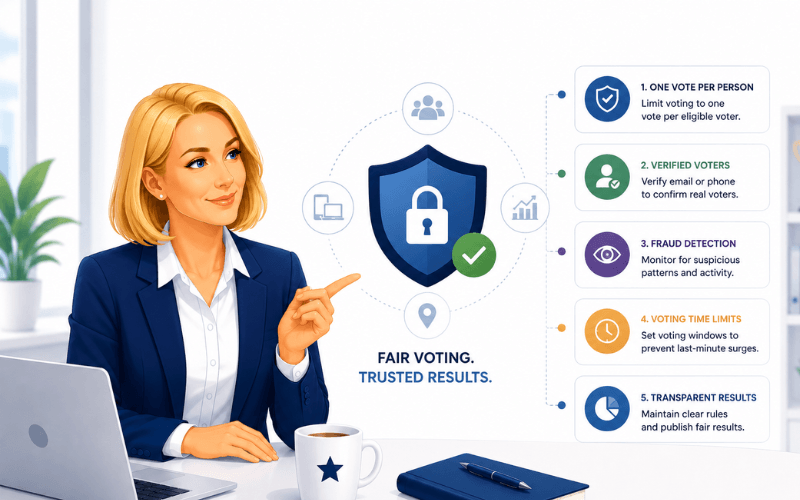
Public voting creates engagement that expert judging can’t match. It also creates vulnerability that expert judging doesn’t face. When outcomes depend on vote counts, incentives exist to inflate those counts through illegitimate means.
Vote manipulation takes many forms, fake accounts, purchased votes, coordinated campaigns exploiting loopholes, bots automating submissions. Some manipulation is sophisticated and difficult to detect. Some is crude but effective when programs lack basic safeguards. All of it undermines the legitimacy that public voting is meant to create.
The challenge isn’t eliminating manipulation entirely, determined actors with sufficient resources can often find ways around safeguards. The challenge is making manipulation difficult enough that most actors don’t attempt it, and detectable enough that attempts can be identified and addressed. Programs that invest in prevention protect their credibility.
This guide covers how to prevent, detect, and respond to vote manipulation, building defenses that protect the integrity your program depends on.
Understanding manipulation types
Effective prevention requires understanding what you’re preventing. Manipulation takes different forms with different characteristics.
Fake account creation
The simplest approach: create multiple accounts to cast multiple votes. This might involve generating email addresses, using temporary email services, or exploiting registration processes that don’t verify identity.
Fake accounts are often detectable through patterns, similar registration times, similar naming conventions, activity only during voting periods, identical voting behavior. But high volumes can be difficult to identify individually.
Purchased votes
Services exist that sell votes for online competitions. Buyers pay for a specified number of votes delivered to their entry. These services use various methods, click farms, compromised accounts, automated systems, to deliver promised volumes.
Purchased votes often arrive in suspicious patterns: sudden spikes, unusual geographic distribution, voting without any other engagement. But sophisticated services attempt to mimic organic voting to avoid detection.
Bot automation
Automated systems can submit votes faster than humans, exploiting any gap in rate limiting or verification. Bots might solve simple CAPTCHAs, rotate IP addresses, or use other techniques to appear legitimate at scale.
Bot traffic often shows technical signatures, unusual browser fingerprints, scripted timing patterns, requests missing typical human characteristics. Detection requires technical monitoring most programs don’t implement.
Coordinated legitimate voting
Not all problematic voting is technically illegitimate. Organised campaigns encouraging supporters to vote can produce outsized results without breaking rules. When an entrant’s marketing team runs aggressive vote mobilisation, outcomes reflect campaign effectiveness rather than broad support.
This isn’t manipulation in the fraudulent sense, but it can produce results that feel manipulated, victories driven by promotional capacity rather than genuine popularity.
Incentivised voting
Offering rewards for voting, discounts, entries into prize draws, access to content, increases participation but may attract votes from people with no genuine interest or knowledge. These votes are technically legitimate but don’t represent authentic preference.
When incentives drive voting, outcomes reflect who offered better incentives rather than who had stronger support.
Social pressure and obligation voting
Organisations that pressure employees, partners, or customers to vote can accumulate votes that don’t reflect genuine preference. “Vote for us or else” dynamics, however subtle, produce compliance rather than support.
These votes are nearly impossible to distinguish from legitimate ones, but they distort what voting is meant to measure.
Prevention through design
The most effective manipulation prevention happens before voting begins, through design choices that make manipulation difficult rather than trying to catch it afterward.
Voter verification
Requiring verification makes fake accounts harder to create at scale.
- Email verification: Voters must confirm their email address before votes count. This prevents votes from unverified or temporary email addresses. It’s a minimal barrier for legitimate voters but significant friction for mass fake account creation.
- Account requirements: Requiring voters to create accounts with verified emails, rather than allowing anonymous voting, creates accountability and enables pattern detection.
- Phone verification: Requiring phone numbers significantly increases fake account difficulty, since phone numbers are harder to generate at scale than email addresses. However, this creates substantial friction that reduces legitimate participation.
- Social login: Allowing voting only through established social media accounts (Google, LinkedIn, Facebook) leverages those platforms’ identity verification. Fake social accounts exist but require more effort than fake email addresses.
- Identity verification: For high-stakes awards, requiring identity documentation eliminates most fake accounts but creates major participation barriers and privacy concerns.
Choose verification levels appropriate to your stakes and audience. Higher verification means more security but less participation.
Rate limiting
Controlling how quickly and frequently voting can occur prevents automated mass voting.
Time-based limits: One vote per account per 24 hours, or one vote per entry per voting period. This prevents rapid vote accumulation from single sources.
IP-based limits: Limiting votes from single IP addresses catches some automated voting but can affect legitimate voters sharing networks (offices, universities, public wifi).
Device fingerprinting: Identifying devices through browser characteristics can detect multiple accounts from the same device, though sophisticated actors can spoof fingerprints.
Rate limiting frustrates casual manipulation attempts. Sophisticated actors may circumvent limits through distributed systems, but the effort required increases significantly.
CAPTCHA and bot detection
Requiring human verification before votes submit blocks automated systems.
Traditional CAPTCHA: Image or text challenges that humans solve easily but bots struggle with. Effectiveness has decreased as AI improves at solving them.
Invisible CAPTCHA: Systems that assess human likelihood through behavior analysis without visible challenges. Less friction for legitimate voters; variable effectiveness against sophisticated bots.
Behavioral analysis: Monitoring mouse movements, typing patterns, and interaction timing to identify non-human behavior. Effective but requires technical implementation.
CAPTCHA adds friction that affects all voters, not just manipulators. Balance security benefits against participation costs.
Voting window design
How you structure the voting period affects manipulation opportunity.
Shorter windows: Brief voting periods (days rather than weeks) limit time for manipulation campaigns to develop and execute.
However, they also limit legitimate participation.
Unpredictable timing: Not announcing exact voting start times in advance prevents pre-positioning of manipulation infrastructure. However, this frustrates legitimate promotional planning.
Staged voting: Multiple voting rounds with elimination between stages makes manipulation more complex, actors must sustain efforts across rounds rather than concentrating resources on single pushes.
Monitoring and detection
Prevention won’t catch everything. Active monitoring during voting identifies problems that defenses missed.
Volume anomaly detection
Sudden vote spikes, especially outside business hours or from unexpected geographies, may indicate manipulation. Establish baseline expectations for voting velocity and investigate significant deviations.
Watch for patterns like:
- Vote counts jumping dramatically within short periods
- Voting velocity inconsistent with promotional activities
- Spikes occurring at unusual times (overnight, weekends when your audience is typically inactive)
Not all anomalies are manipulation, viral social sharing can produce legitimate spikes. But anomalies warrant investigation.
Geographic pattern analysis
Review where votes originate. Dramatic over-representation from regions unconnected to the entrant or your program may indicate purchased votes from click farms concentrated in specific locations. If an entry claims local community support but votes arrive primarily from distant countries, something is wrong. If voting patterns don’t match your known audience geography, investigate.
Account behavior analysis
Examine voter accounts for suspicious patterns:
Single-purpose accounts: Created recently, voted once, no other activity. One such account is normal; hundreds suggest fake account creation.
Coordinated timing: Multiple accounts voting within seconds of each other, following identical patterns. This suggests automation or coordinated campaigns.
Identical characteristics: Accounts with similar usernames, registration patterns, or profile information. Mass-created accounts often share detectable similarities.
Voting pattern analysis
Look at how votes are distributed:
Unnatural distribution: If one entry receives votes in perfectly consistent intervals while others show natural variation, the consistency may indicate automation.
Last-minute surges: Suspicious vote accumulation in final hours of voting may indicate manipulation timed to avoid detection until it’s too late to respond.
Correlation with promotion: Legitimate votes typically correlate with promotional activity, social posts, email campaigns, press coverage. Votes arriving without corresponding promotion warrant questions.
Technical safeguards
Beyond design choices, technical implementations provide additional protection.
Database and logging
Maintain detailed records of voting activity:
- Timestamp of every vote
- Account information for each voter
- IP address and geographic data
- Device fingerprint where possible
- Referral source (how voter reached the voting page)
These records enable investigation when anomalies appear and support enforcement decisions with evidence.
Real-time alerts
Configure automated alerts for suspicious patterns:
- Vote velocity exceeding thresholds
- Multiple votes from single IPs within short periods
- Unusual geographic concentrations
- New account creation spikes during voting
Alerts enable rapid response rather than discovering problems after voting closes.
Third-party tools
Fraud detection services exist for online voting and competitions. These tools apply machine learning and pattern recognition across many clients to identify manipulation signatures. They’re more sophisticated than most programs can build internally but add cost and complexity.
Evaluate whether your program’s stakes justify third-party investment.
Response protocols
When manipulation is suspected, having established protocols enables consistent, defensible response.
Investigation process
Before taking action, investigate thoroughly:
- Document evidence: Capture data supporting your suspicion, vote patterns, account information, timing analysis. This documentation supports decisions and protects against disputes.
- Consider alternatives: Could the pattern have legitimate explanations? Viral sharing, coordinated but legitimate campaigns, or promotional timing might explain what looks suspicious.
- Determine scope: Is this isolated to one entry or affecting multiple? Understanding scope informs response proportionality.
Response options
Depending on investigation findings, responses might include:
Vote removal: Removing votes identified as fraudulent while preserving legitimate ones. This requires confidence in distinguishing between them.
Entry disqualification: Removing entries found to have engaged in or benefited from manipulation. This is a significant action requiring clear evidence and policy basis.
Account suspension: Blocking accounts identified as fraudulent from further participation. This prevents ongoing manipulation but doesn’t address votes already cast.
Result adjustment: Recalculating results after removing fraudulent votes. Communicate adjustments transparently rather than quietly changing numbers.
No action: If investigation doesn’t support manipulation conclusions, document findings and continue monitoring. Not every anomaly requires response.
Communication approach
How you communicate about manipulation affects program credibility:
If manipulation is confirmed: Acknowledge it happened, explain what you found, describe your response, and reinforce your commitment to integrity. Transparency builds trust even when revealing problems.
If investigation is inconclusive: You may choose not to communicate publicly about suspicions you couldn’t confirm. Avoid making accusations you can’t support.
If accused unfairly: If entrants or observers allege manipulation that investigation doesn’t support, respond with facts. Explain what you examined and why conclusions weren’t warranted.
Policy framework
Establish manipulation policies before voting begins, not when problems emerge.
Define prohibited conduct
Specify what’s not allowed:
- Creating fake accounts to cast multiple votes
- Purchasing votes or using vote-selling services
- Using bots or automated systems to submit votes
- Incentivising votes through rewards, compensation, or coercion
- Any other conduct intended to artificially inflate vote counts
Clear definitions enable enforcement and put entrants on notice.
State consequences
Explain what happens if manipulation is detected:
Fraudulent votes will be removed
Entries benefiting from manipulation may be disqualified
Individuals or organisations found manipulating may be barred from future programs
Consequences create deterrence when communicated upfront.
Require attestation
Consider requiring entrants to attest that they won’t engage in prohibited conduct. This won’t stop determined manipulators but creates a documented commitment that supports enforcement.
Reserve discretion
Include language reserving your right to take action against manipulation not specifically enumerated. Manipulators find creative approaches; your policy shouldn’t limit response to only what you anticipated.
Balancing security and accessibility
Every security measure creates friction that affects legitimate voters. Perfect security would require verification so burdensome that few would participate. No security invites manipulation that undermines results entirely.
Find balance appropriate to your context:
- Low-stakes programs: Community recognition, internal awards, or programs where outcomes have limited commercial value can use lighter security. Email verification and basic rate limiting may suffice. The cost of manipulation is low, so elaborate prevention isn’t justified.
- Medium-stakes programs: Industry awards with meaningful professional recognition warrant stronger measures. Verified accounts, CAPTCHA, geographic monitoring, and anomaly detection protect outcomes that matter to participants and industry credibility.
- High-stakes programs: Awards with significant commercial value, media attention, or competitive intensity require robust protection. Multi-factor verification, sophisticated fraud detection, and active monitoring throughout voting periods may be appropriate.
Match your investment in prevention to the value at stake and the likelihood of manipulation attempts.
Communication about integrity
How you talk about voting integrity affects both deterrence and trust.
Before voting
Communicate that you take integrity seriously:
- Publish your voting rules and prohibited conduct
- Explain that monitoring occurs throughout voting
- State consequences for manipulation
- Describe your verification and security measures (at appropriate level of detail)
This communication deters casual manipulation and reassures legitimate participants that results will be meaningful.
During voting
Avoid detailed public discussion of specific monitoring or detection methods, this helps manipulators understand what to avoid. But periodic reminders that monitoring is active reinforce deterrence.
If you detect and address manipulation mid-voting, consider whether to communicate this. Public acknowledgment demonstrates vigilance but may encourage entrants to question results more broadly.
After voting
When announcing results, you might note that integrity measures were in place without detailed discussion unless problems occurred. If manipulation was detected and addressed, transparency about what happened and how you responded builds long-term trust.
The limits of prevention
No prevention system is perfect. Determined, well-resourced actors can often find ways around safeguards. The goal isn’t elimination but reduction, making manipulation difficult enough that most actors don’t attempt it and detectable enough that attempts can be addressed.
Accept that some manipulation may occur undetected. Design your program so that even imperfect voting produces directionally meaningful results, the entry with strongest genuine support wins even if some fraudulent votes exist on both sides.
Consider whether public voting remains appropriate if manipulation risk is too high to manage. Some programs conclude that expert judging better serves their purpose than voting they can’t adequately protect. This isn’t failure; it’s recognising that different evaluation methods suit different contexts.
Public voting done well creates engagement and legitimacy that expert judging alone can’t match. Public voting done poorly, with outcomes visibly determined by manipulation rather than genuine support, damages credibility more than having no voting at all. Invest in prevention proportionate to your stakes, monitor actively, respond decisively, and be prepared to adjust your approach if integrity can’t be maintained.
Frequently Asked Questions
The best way to reduce vote manipulation is to design the voting process with safeguards from the outset. Measures such as voter verification, account registration, rate limiting, CAPTCHA protection, and carefully structured voting windows make it much harder to inflate results through fake accounts or automated systems.
While no system can eliminate manipulation entirely, strong preventive measures significantly increase the effort required to cheat and protect the credibility of the awards program
Award programmes may encounter several forms of manipulation, including:
Fake account creation
Purchased votes from third-party services
Automated bot voting
Coordinated voting campaigns that exploit loopholes
Incentivised voting through rewards or competitions
Organisational pressure on employees or customers to vote
Understanding these tactics helps organisers implement appropriate safeguards before voting begins.
Verification methods make it more difficult to create fake votes at scale. Depending on the programme's needs, organisers may use verified email addresses, registered user accounts, phone verification, social media logins, or identity checks for higher-stakes awards.
The appropriate level of verification depends on balancing voting security with an accessible user experience.
Monitoring voting patterns helps identify potential manipulation before results are finalised. Warning signs include sudden vote spikes, unusual geographic concentrations, recently created accounts, repeated voting from similar devices or IP addresses, and voting behaviour that does not match normal promotional activity.
These anomalies do not always indicate fraud, but they should trigger further investigation before winners are confirmed.
If manipulation is suspected, organisers should first collect evidence, investigate alternative explanations, and determine the scale of the issue before taking action. Depending on the findings, they may remove fraudulent votes, disqualify entries, suspend accounts, adjust results, or continue monitoring if there is insufficient evidence.
A documented investigation process helps ensure decisions remain fair and defensible.
Clear voting policies set expectations before voting begins by defining prohibited behaviour, explaining how votes are monitored, outlining possible penalties, and describing the programme's commitment to fair competition.
Publishing these rules helps deter manipulation while giving organisers a transparent basis for enforcement if problems arise.
Every security measure adds some friction for legitimate voters, so organisers should choose safeguards that match the value and visibility of the awards. Community awards may require only basic verification, while prestigious industry awards often justify stronger identity checks and fraud monitoring.
Matching security measures to the programme's level of risk protects integrity without unnecessarily discouraging participation.
No. Determined individuals may still attempt to bypass even sophisticated security measures. The goal is not to eliminate every possible threat but to make manipulation difficult, costly, and detectable enough that genuine public support determines the outcome in most cases.
Strong prevention, active monitoring, and transparent responses to confirmed issues are the most effective way to maintain confidence in public voting.