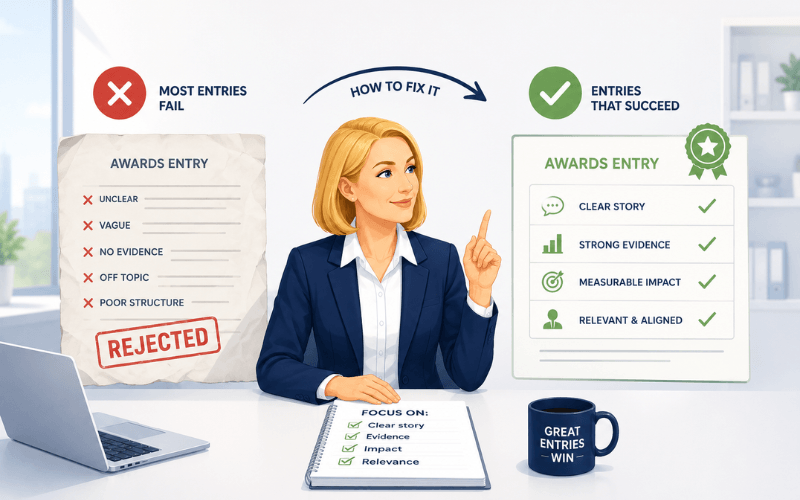
Most award entries fail because the submission didn’t communicate the work effectively. This is a frustrating reality for organisations with genuine achievements. You’ve done excellent work, you know it deserves recognition, but the entry you submitted didn’t land. The judges saw something different from what you intended to show them. The gap between what you achieved and what you communicated cost you the win.
The good news is that entry failure follows predictable patterns. The same mistakes appear across industries, categories, and program types. Understanding these patterns, and knowing how to avoid them, dramatically improves your chances of success. Not because you’re gaming the system, but because you’re finally showing judges what they need to see.
This guide covers why entries fail and, more importantly, how to fix each problem. Whether you’re entering awards for the first time or wondering why previous submissions haven’t succeeded, these principles apply.
The fundamental problem
Judges only see what you show them
Judges don’t know your organisation. They don’t know your challenges, your constraints, or the context that makes your achievements impressive. They know only what appears in your submission.
This seems obvious, but most entries are written as if judges already understand the background. Entrants reference achievements without explaining why they matter, cite metrics without providing context, and assume judges will connect dots that haven’t been drawn.
Judges are evaluating dozens of entries, sometimes more. They can’t research your company, fill in gaps, or give you the benefit of the doubt on unclear points. If your submission doesn’t make the case clearly, the case doesn’t get made.
The entries that succeed aren’t necessarily from organisations with the best achievements. They’re from organisations that communicated their achievements most effectively within the constraints of the entry form. This isn’t unfair, it’s how evaluation works. Your job is to make the judge’s job easy.
The seven reasons entries fail
Entry failure clusters around a predictable set of problems. Most weak submissions exhibit several of these patterns simultaneously.
1. Vague claims instead of specific evidence
The most common failure. Entries filled with statements like “significant improvement,” “industry-leading results,” “exceptional customer satisfaction,” and “transformational impact” without concrete evidence to support them.
These phrases feel meaningful when you write them. You know what “significant improvement” means in your context. But judges see hundreds of “significant improvements” , the phrase conveys nothing without specifics.
Vague: “We achieved significant growth in customer satisfaction.”
Specific: “Customer satisfaction scores increased from 72% to 89% over twelve months, measured through quarterly NPS surveys with 2,400 respondents.”
The specific version tells judges something they can evaluate. The vague version tells them nothing.
2. Features described instead of outcomes demonstrated
Many entries focus on what was built, launched, or implemented rather than what it achieved. They describe the solution in detail but skip past the results.
Judges don’t award points for activity. They award points for impact. A beautifully designed product that didn’t demonstrably improve anything isn’t a strong entry, however impressive the design work.
Feature-focused: “We implemented a new AI-powered recommendation engine using machine learning algorithms trained on three years of customer data.”
Outcome-focused: “Our recommendation engine increased average order value by 23% and reduced product returns by 15%, generating £2.4M in additional annual revenue.“
The feature is only relevant because of the outcome. Lead with results, then explain how you achieved them.
3. Wrong category selection
Entering the wrong category is surprisingly common, and it’s often fatal. An excellent entry in the wrong category loses to a mediocre entry in the right one.
Category mismatch happens in several ways. Entrants choose categories based on what sounds most prestigious rather than what fits best. They enter innovation categories with work that’s well-executed but not genuinely novel. They enter impact categories without measurable outcomes. They enter leadership categories with team achievements.
Before entering any category, read the description and criteria carefully. Ask yourself: does my work genuinely fit what this category is designed to recognise? If you’re stretching to make it fit, it probably doesn’t fit.
4. Marketing language instead of evaluation content
Entries often read like press releases or sales brochures, polished, promotional, and devoid of substance judges can actually assess.
Marketing language is designed to create positive impressions. Evaluation content is designed to demonstrate specific achievements against specific criteria. These are different purposes, and the writing that serves one often undermines the other.
Marketing language: “Our revolutionary platform is transforming how businesses connect with customers, delivering unprecedented value through cutting-edge technology and world-class service.”
Evaluation content: “The platform reduced customer response time from 4 hours to 12 minutes on average, while handling 340% more inquiries with the same team size. Customer satisfaction increased from 76% to 91%.”
Judges see through promotional language. It signals that you don’t have substance to share. Drop the superlatives and show the evidence.
5. Missing context that makes achievements meaningful
Numbers without context are impossible to evaluate. “We increased revenue by 15%” sounds good, but is it impressive? That depends on market conditions, company stage, industry benchmarks, and what investment was required to achieve it.
Entries often assume judges understand the context that makes achievements meaningful. They don’t. A 15% revenue increase might be exceptional for a mature company in a declining market, or unremarkable for a startup in a growth sector. Without context, judges can’t tell.
Without context: “We grew revenue by 15% year-over-year.”
With context: “We grew revenue by 15% in a market that contracted 8% overall, without increasing headcount or marketing spend. This outperformed our three closest competitors, who averaged 3% growth.”
Context transforms a number into an achievement. Provide the frame that makes your results meaningful.
6. Not answering the actual questions
Entry forms ask specific questions for specific reasons. Those questions are usually aligned with judging criteria. When entrants don’t answer them directly, they’re not providing the information judges need to score them well.
This happens when entrants have a narrative they want to tell and force it into every answer, regardless of what was asked. It happens when entrants copy from previous submissions without adapting to the current form. It happens when entrants don’t read questions carefully enough.
Question asked: “What specific challenge or problem did this project address?”
Poor answer: “Our company has been an industry leader for over twenty years, known for our commitment to excellence and customer focus. This project reflects our ongoing dedication to innovation…”
Better answer: “Customer churn had increased from 8% to 14% over eighteen months, costing approximately £1.2M annually. Exit surveys indicated that slow response times and inconsistent service quality were primary drivers.”
Read each question. Answer that question. Resist the temptation to redirect every answer toward your preferred narrative.
7. Weak or missing evidence
Claims require proof. Entries that assert outcomes without supporting evidence ask judges to take assertions on faith, and judges, reasonably, don’t.
Evidence can take many forms: metrics with methodology, customer testimonials, third-party validation, before-and-after comparisons, independent research, media coverage, or other documentation that supports your claims.
Claim without evidence: “Our program significantly improved employee engagement and retention.”
Claim with evidence: “Employee engagement scores increased from 67% to 84% (annual survey, 92% response rate). Voluntary turnover dropped from 18% to 11% in the twelve months following launch. Three team members were promoted internally, compared to zero in the previous two years.”
If you can’t provide evidence for a claim, either find the evidence or reconsider making the claim.
How to fix your entries
Understanding failure patterns is only half the solution. Here’s how to address each problem.
Start with the criteria, not your narrative
Before writing anything, study the judging criteria. What specific dimensions will judges evaluate? What weighting does each criterion carry? What evidence would demonstrate excellence against each one?
Map your achievements against the criteria. Identify where you’re strong and where you’re weak. Build your entry around demonstrating strength in high-weighted areas, not around the story you originally wanted to tell.
The entry should answer the judges’ questions, not broadcast your preferred message.
Strong entries follow a consistent pattern: they establish Context, describe Action, present Results, and provide Evidence.
Context: What was the situation, challenge, or opportunity? What constraints existed? Why did this matter?
Action: What specifically did you do? What decisions did you make? What was your approach?
Results: What happened? What changed? What outcomes can you demonstrate?
Evidence: How can you prove it? What data, testimonials, or documentation supports your claims?
This structure works because it gives judges the information they need in the order they need it. Context makes results meaningful. Actions explain how results were achieved. Evidence makes claims credible.
Quantify everything you can
Numbers are more credible than adjectives. “Significant improvement” is a claim. “47% improvement” is a fact.
Look for ways to quantify achievements you might have described qualitatively:
- Instead of “faster”: “reduced from 4 days to 6 hours”
- Instead of “more efficient”: “same output with 30% fewer resources“
- Instead of “improved satisfaction”: “NPS increased from 32 to 67“
- Instead of “successful launch”: “acquired 12,000 customers in first 90 days”
Not everything can be quantified, but more can be quantified than most entries attempt. Find the numbers.
Provide comparison points
Raw numbers need reference points to become meaningful. Comparison points help judges understand whether your achievements are impressive.
Useful comparisons include:
- Before versus after (the most common and often most powerful)
- You versus industry average or benchmark
- You versus competitors (if you can cite appropriately)
- You versus your own targets or projections
- This period versus previous periods
“We achieved 89% customer satisfaction” is okay. “We achieved 89% customer satisfaction, up from 71% the previous year and above the industry average of 78%” is much stronger.
Answer questions directly, then expand
For each entry question, start with a direct answer to what was asked. Then provide supporting detail.
This structure ensures judges get the core information immediately, even if they’re skimming. It also forces you to actually answer the question rather than pivoting to tangentially related content.
Question: “What made this approach innovative?”
Direct answer first: “This was the first application of predictive analytics to maintenance scheduling in our sector.”
Then expand: “Previous approaches relied on fixed schedules or reactive repairs. By analysing equipment sensor data against historical failure patterns, we could predict maintenance needs 2-3 weeks in advance, reducing unplanned downtime by 64%.”
Cut the superlatives
Words like “revolutionary,” “world-class,” “cutting-edge,” “best-in-class,” and “unparalleled” are red flags to judges. They signal promotion over substance.
Remove every superlative from your entry. If the achievement is genuinely impressive, the evidence will show it. If you need superlatives to make it sound impressive, the evidence probably isn’t there.
Review your draft specifically for promotional language. Ask yourself: would I use this phrase if I were writing an internal report rather than an external submission? If not, cut it.
Get someone unfamiliar to read it
Your entry makes sense to you because you know the context. Test whether it makes sense to someone who doesn’t.
Find a colleague unfamiliar with the project and ask them to read your entry. Can they explain what you did, why it mattered, and what you achieved? Do they have questions the entry doesn’t answer? Do they find any claims unconvincing?
Fresh eyes catch assumptions and gaps that you’ve become blind to. This feedback is invaluable before submission.
Respect word limits
Word limits exist to ensure entries are comparable and to prevent judges from being overwhelmed. Treat them as constraints that force clarity, not obstacles to work around.
If you can’t fit everything in the word limit, you’re probably including too much. Focus on your strongest evidence for the highest-weighted criteria. Cut background that doesn’t directly support your case. Eliminate redundancy.
Concise entries that hit the key points score better than lengthy entries that bury important information in padding.
Category selection: getting it right
Choosing the right category is one of the highest-leverage decisions in the entry process. A strong entry in the wrong category loses; a solid entry in the right category can win.
Read category descriptions carefully
Don’t assume you know what a category covers based on its title. “Innovation” categories vary widely in what they actually recognise. Some reward technical novelty; others reward creative application of existing approaches; others focus on business model innovation.
Read the full category description and judging criteria. Understand what specifically will be evaluated and how it will be weighted.
Assess fit honestly
Ask yourself: does my work genuinely exemplify what this category recognises?
If you’re entering an innovation category, is your work actually innovative, or is it well-executed but conventional? If you’re entering an impact category, do you have measurable outcomes, or just activities? If you’re entering a leadership category, is this about an individual’s leadership, or a team achievement?
Judges notice when entries don’t fit. Forcing a square peg into a round hole rarely works.
When in doubt, ask
Many program s offer guidance on category selection. Contact the organisers with a brief description of your work and ask which category would be the best fit. They want strong entries in appropriate categories, they’ll usually help.
Consider multiple categories carefully
Entering multiple categories can increase your chances, but only if your work genuinely fits each one. Entering six categories with the same content adapted slightly for each is usually less effective than entering two categories where you have strong fit.
Each category entry should be tailored to that category’s specific criteria. If you’re just copying and pasting, you’re probably not doing this effectively.
The role of the entry process
Sometimes entry failure isn’t your fault. Poorly designed entry forms with vague questions, misaligned criteria, and inadequate guidance make strong entries harder to create.
If you’re struggling to understand what an entry form is asking, or how your work should be presented, the problem may be with the form rather than with your approach. Look for:
- Entry guidance documents or FAQs
- Sample entries or examples of strong submissions
- Contact information for questions
- Webinars or briefings for potential entrants
Program organisers want high-quality entries. If the form isn’t giving you what you need, ask for clarification.
That said, even with imperfect entry forms, the principles in this guide apply. Answer questions directly, provide specific evidence, quantify where possible, and focus on outcomes rather than activities. These practices work regardless of how well the entry process is designed.
The final checklist before you submit
Review your entry against these questions before submitting:
Clarity
- Would someone unfamiliar with your work understand what you did and why it matters?
- Have you answered each question directly and specifically?
- Is the entry free of jargon that judges might not understand?
Evidence
- Are claims supported with specific evidence, not just assertions?
- Have you quantified outcomes wherever possible?
- Have you provided context that makes numbers meaningful?
Fit
- Does your work genuinely match what this category recognises?
- Have you addressed the specific judging criteria?
- Is the entry tailored to this program , not recycled from another submission?
Quality
- Is the entry within word limits?
- Is it free of typos, errors, and inconsistencies?
- Does it avoid promotional language and superlatives?
Completeness
- Have you provided all required supporting materials?
- Are links working and files accessible?
- Have you met all eligibility requirements?
The difference between good work and good entries
Good work doesn’t automatically produce good entries. The translation from achievement to submission requires deliberate effort, understanding what judges need, structuring information effectively, and providing evidence that supports your claims.
This is about communication, the clearest, most evidence-based presentation of genuine achievements wins over vague descriptions of potentially better achievements that judges can’t properly evaluate.
Your work deserves to be understood. Give judges what they need to understand it.
Frequently Asked Questions
The biggest reason award entries fail is that judges can only evaluate what is clearly presented in the submission, not the quality of the work itself. Strong achievements often lose because the entry relies on assumptions, vague claims, or missing context instead of explaining why the results matter with clear evidence.
Successful submissions bridge the gap between achievement and communication by making the judge's job easy with specific facts, measurable outcomes, and supporting proof.
Statements such as "significant improvement" or "industry-leading results" carry little value unless they are backed by measurable evidence. Judges compare many entries, so broad claims without numbers or context are difficult to assess objectively.
A stronger approach is to include precise metrics, timeframes, methodologies, and comparisons. For example, reporting that customer satisfaction increased from 72% to 89% over twelve months provides evidence judges can evaluate.
Award judges score impact rather than activity. Describing a product launch, new technology, or service improvement is only valuable if it is linked to measurable business or customer outcomes.
Effective entries explain what changed because of the initiative, such as increased revenue, reduced costs, improved customer satisfaction, or higher operational efficiency, before explaining how those results were achieved.
Even a strong submission can perform poorly if it is entered into a category that does not match its strengths. Judges evaluate entries against category-specific criteria, so a mismatch can prevent excellent work from scoring well.
Before entering, review the category description carefully, assess whether your achievements genuinely fit the judging criteria, and seek guidance from organisers if there is uncertainty.
The CARE structure is a practical framework that helps present achievements in a logical, evidence-based way:
Context: Explain the challenge or opportunity.
Action: Describe what was done.
Results: Show measurable outcomes.
Evidence: Prove the claims with data, testimonials, or documentation.
Using this structure ensures judges receive the information they need in the right order to evaluate the submission effectively.
Promotional phrases such as "revolutionary," "world-class," or "cutting-edge" do not help judges score an entry because they are opinions rather than evidence. Overusing superlatives can make a submission appear less credible.
Instead, replace promotional language with measurable achievements, comparisons, and verified results that demonstrate success without exaggeration.
Numbers alone rarely show whether an achievement is exceptional. Judges need context to understand how difficult the result was and why it deserves recognition.
Providing comparisons, such as performance against previous years, industry averages, market conditions, or internal targets, helps demonstrate the significance of the outcome and strengthens the overall submission.
A final review should confirm that every question has been answered directly, all claims are supported by evidence, and the submission aligns with the judging criteria. It is also important to ensure supporting documents are complete, links work correctly, and the entry complies with word limits and eligibility requirements.
Having someone unfamiliar with the project review the submission can also identify unclear explanations or missing context before it reaches the judges.