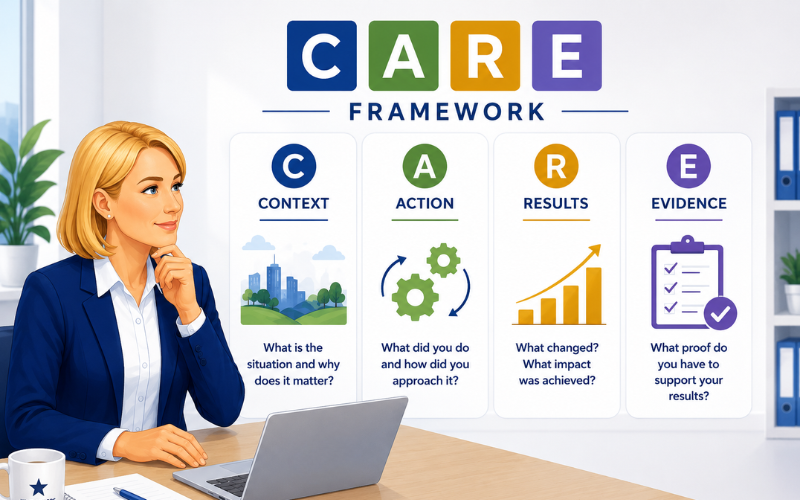
Strong award entries share a common structure, even when entrants don’t realise they’re following one. They establish the situation before explaining what was done. They describe actions before claiming results. They support results with evidence rather than leaving claims unverified.
This pattern Context, Action, Results, Evidence isn’t complicated, but it’s surprisingly rare in practice. Most entries skip context entirely, blur the line between actions and results, or assert outcomes without supporting evidence. Judges are left to piece together what happened, why it mattered, and whether they should believe the claims being made.
The CARE framework makes this structure explicit. It gives entrants a reliable pattern for presenting achievements clearly, and it gives programme organisers a foundation for designing entry forms that produce comparable, evaluable submissions.
This guide explains each element of the framework, why it matters, and how to apply it, whether you’re writing an entry or designing a form that helps others write better ones.
Why structure matters in award entries
Judges evaluate dozens of entries, sometimes more. They can’t spend twenty minutes deciphering each submission, hunting for relevant information, or filling in gaps that entrants left open.
Entries that follow a clear structure are easier to evaluate. Judges find what they need quickly, understand how elements connect, and can focus on assessing quality rather than extracting meaning. Entries without structure force judges to do interpretive work , figuring out what the entrant meant, what sequence events followed, and what claims are actually being made.
This interpretive burden affects scoring. When judges must work to understand an entry, they’re more likely to miss important details, misunderstand context, or simply score lower because frustration colours their evaluation. Clarity is not just convenient, it directly affects outcomes.
The CARE framework provides that clarity.
Each element answers a specific question judges need answered, in the order they need to answer it. Context establishes why the work mattered. Action explains what was done. Results demonstrate what changed. Evidence proves the claims are credible.
When entries follow this structure, comparison becomes straightforward. Judges evaluate substance rather than presentation skill, and outcomes reflect achievement quality rather than communication ability.
Establishing why this matters
Context is the most frequently skipped element in award entries, and its absence undermines everything that follows.
Without context, achievements exist in a vacuum. A 15% revenue increase sounds good, but is it impressive? That depends on market conditions, company stage, starting point, and competitive dynamics. A successful product launch might be remarkable or routine depending on what challenges were overcome to achieve it.
Context answers the question: what was the situation before this work began?
What context should include
The challenge, problem, or opportunity being addressed. What prompted this work? What wasn’t working, or what potential existed that wasn’t being captured?
Relevant constraints or conditions. What limitations shaped the approach? Budget restrictions, timeline pressures, technical constraints, organisational challenge, these details help judges understand what “success” required.
Why this mattered. What were the stakes? Who was affected? What would have happened without intervention? This establishes significance before you claim success.
Scale and scope. How big was this challenge? How many people, customers, transactions, or processes were involved? Scale affects how judges interpret results.
Context done poorly
Vague: “We faced significant challenges in our customer service operations.”
This tells judges nothing specific. What challenges? How significant? What did “customer service operations” encompass?
Context done well
Specific: “Customer complaints had increased 40% over eighteen months, with average resolution time growing from 2 days to 11 days. Our NPS had dropped from 42 to 19, and we were losing approximately 200 customers monthly to competitors citing service issues. With a team of just 12 handling 3,000 monthly inquiries, we needed a fundamentally different approach, not incremental improvement.”
This gives judges a clear picture of the starting point. They understand the scale of the problem, the constraints involved, and why action was necessary. When results are presented later, judges can evaluate them against this baseline.
How much context is enough
Context should be substantial enough to make results meaningful, but concise enough to leave room for other elements. For most entries, 100–150 words provides adequate framing. Complex situations might warrant 200 words, but more than that usually indicates context is drifting into background padding.
The test: after reading your context, would a judge unfamiliar with your organisation understand why this work mattered and what success would require?
Action: explaining what you actually did
Action describes the work itself, the decisions made, approaches taken, and activities completed. This is where entrants explain how they addressed the challenge established in context.
Action answers the question: what specifically did you do?
What action should include
The approach or strategy. What method, framework, or philosophy guided the work? Why was this approach chosen over alternatives?
- Key decisions. What choices shaped the outcome? Decisions reveal judgement and intentionality, they show that results came from thoughtful action, not luck.
- Specific activities. What was actually done? Not vague descriptions of “implementing solutions” but concrete actions that judges can understand and evaluate.
What made this distinctive. What set your approach apart from conventional alternatives? This is particularly important for innovation-focused categories.
Action done poorly
Vague: “We implemented a comprehensive customer service transformation programme, leveraging technology and process improvements to enhance the customer experience.”
This could describe almost anything. “Comprehensive,” “leveraging,” and “enhance” are filler words that obscure rather than reveal.
Action done well
Specific: “We restructured the team into specialist pods handling distinct inquiry types, reducing context-switching and enabling deeper expertise. We implemented an AI triage system that categorised and routed 70% of inquiries automatically, freeing agents for complex cases.
We replaced our ticketing system with a platform enabling real-time collaboration, eliminating the back-and-forth that had extended resolution times. And we introduced a ‘resolution authority’ policy allowing agents to make decisions up to £500 without escalation.”
This tells judges exactly what was done. Each action is concrete and understandable. The approach is clear, and judges can evaluate whether these actions would plausibly produce the results claimed later.
Balancing detail and brevity
Action sections often become bloated because entrants want to demonstrate how much work was involved. But judges don’t need exhaustive detail, they need enough information to understand the approach and evaluate its quality.
Focus on the most significant actions, the decisions that most directly produced results. If you implemented twenty initiatives, highlight the four or five that mattered most. You can acknowledge broader scope without describing everything in equal detail.
For most entries, 150–200 words provides adequate coverage of actions. If you’re consistently exceeding this, you’re probably including detail that doesn’t help judges evaluate your work.
Results: demonstrating what changed
Results are typically the most heavily weighted element in judging, and the most frequently underdeveloped in entries. Many submissions describe extensive activities but rush past outcomes, offering vague claims rather than specific evidence of change.
Results answer the question: what happened because of this work?
What results should include
- Specific outcomes. What measurably changed? Not activities completed but outcomes achieved. “We trained 500 staff” is an activity. “Customer satisfaction increased from 72% to 91%” is a result.
- Quantification where possible. Numbers are more credible than adjectives. “Significant improvement” is a claim; “47% improvement” is a fact. Wherever outcomes can be quantified, they should be.
- Timeframes. When were these results achieved? Over what period? Results without timeframes are difficult to evaluate, a 20% improvement over five years is very different from 20% over six months.
- Comparison points. Results need reference points to become meaningful. Before versus after is the most common and often most powerful comparison. Other useful comparisons include: versus target, versus industry benchmark, versus competitors, versus previous periods.
Results done poorly
Vague: “The programme delivered significant improvements in customer satisfaction and operational efficiency, exceeding our expectations and positioning us for future growth.”
This tells judges nothing specific. What improvements? How significant? What were your expectations? This is marketing language, not evaluation content.
Results done well
Specific: “Resolution time dropped from 11 days to 18 hours. Customer satisfaction scores increased from 19 to 67 NPS. Monthly customer losses to competitors fell from 200 to 31. We now handle 4,200 monthly inquiries with the same 12-person team, a 40% volume increase with no additional headcount. These results were achieved within eight months of implementation and have sustained for fourteen months since.”
Judges can evaluate this. Every claim is specific, quantified, and timeframed. The results clearly connect to the context established earlier (resolution time, NPS, customer losses). Judges understand exactly what was achieved.
Connecting results to context
Strong results sections explicitly reference the context established earlier. This connection demonstrates that results address the actual problem, not just that good things happened, but that the specific challenges described were resolved.
If context mentioned 11-day resolution times, results should report what resolution times became. If context mentioned NPS of 19, results should report the new NPS. This mirroring makes the achievement tangible and the improvement undeniable.
Evidence: proving your claims are credible
Evidence separates substantiated achievements from unverifiable assertions. It answers the question judges may not ask aloud but always consider: why should I believe this?
Many entries present impressive results but provide no way for judges to verify the claims. Judges aren’t necessarily sceptical, but they’ve seen enough inflated claims to appreciate when entrants support their assertions with proof.
What evidence can include
- Methodology for metrics. How were the numbers calculated? What data sources were used? Brief methodology explanation makes claims more credible.
- Third-party validation. Independent recognition, awards from other bodies, analyst mentions, media coverage, or industry rankings provide external confirmation.
- Customer or stakeholder testimonials. Direct quotes from customers, partners, or other stakeholders who experienced the work firsthand.
- Before/after documentation. Screenshots, reports, or other artefacts showing the situation before and after the work.
Audit or verification statements. For financial or operational claims, confirmation from accountants, auditors, or other independent parties.
Evidence done poorly
Absent: Many entries simply omit evidence entirely, expecting judges to accept claims at face value.
Weak: “Our customers are very satisfied with the improvements.” This is a claim about evidence, not actual evidence.
Evidence done well
Specific: “Customer satisfaction is measured through quarterly NPS surveys with 2,400 respondents (92% response rate). Third-party mystery shopping conducted by ServiceTrack confirmed our scores, rating us ‘exceptional’ across all five evaluation criteria, up from ‘needs improvement’ eighteen months earlier.
Selected customer quotes: ‘Response times have transformed, what used to take days now takes hours’ (Operations Director, ClientCo); ‘The difference is night and day’ (Procurement Lead, RetailGroup).”
This gives judges confidence in the claims. The methodology is clear, external validation exists, and specific testimonials add human confirmation.
How much evidence is enough
Evidence doesn’t need to be exhaustive, judges aren’t conducting audits. But it should be sufficient to make claims credible. For most entries, 100–150 words of evidence description plus optional supporting document uploads provides adequate substantiation.
The principle: every significant claim should have at least some supporting evidence. The more impressive the claim, the more important evidence becomes.
Applying CARE to entry design
The CARE framework works in two directions. Entrants can use it to structure their submissions. Programme organisers can use it to design entry forms that elicit clear, comparable responses.
For entrants
Before writing, map your content to the four elements:
- What context will help judges understand why this work mattered?
- What actions were most important to achieving results?
- What specific, quantified results can you demonstrate?
- What evidence supports your claims?
Draft each section separately, ensuring you address each element before combining them. Review to confirm that context establishes the baseline results will be measured against, that actions plausibly connect to results claimed, and that evidence supports the most important claims.
For programme organisers
Design entry forms with questions corresponding to each element:
Context: “What challenge or opportunity did this work address?”
Action: “What approach did you take and what key decisions shaped your work?”
Results: “What measurable outcomes did you achieve?”
Evidence: “What evidence supports these results?”
This structure guides entrants toward complete, evaluable submissions. It also makes judging more consistent, every entry addresses the same elements in the same sequence, enabling like-for-like comparison.
Word limits for each element ensure appropriate balance. Context might receive 100–150 words, Action 150–200, Results 150–200, and Evidence 100–150 or a supporting document upload. These constraints prevent any element from dominating while ensuring all receive adequate attention.
Common CARE mistakes to avoid
Even when following the framework, certain patterns undermine entry quality.
Context that’s actually background
Context should establish the specific situation this work addressed, not provide general company history or industry overview. “Founded in 2005, we are a leading provider of…” is background, not context. Keep context focused on the challenge at hand.
Actions described as results
“We launched a new platform” is an action, not a result. “Platform usage reached 50,000 monthly active users” is a result. Don’t claim credit for activities, demonstrate what those activities achieved.
Results without connection to context
If your context describes one problem and your results address something different, judges notice the disconnect. Ensure results directly respond to the challenges established in context.
Evidence that repeats claims
“Our results demonstrate significant improvement” isn’t evidence, it’s restating the claim. Evidence must be independent of the claim it supports: methodology, third-party validation, testimonials, documentation.
Making CARE work for different categories
The framework adapts to different category types while maintaining its core structure.
For innovation categories, the Action section emphasises what was novel about the approach. Results might include adoption metrics alongside impact measures. Evidence might reference patents, industry recognition, or expert validation of novelty.
For impact categories, Results dominates. Context establishes the scale of the challenge, and Evidence substantiates the outcomes claimed. Action matters less than outcomes achieved.
For leadership categories, Action focuses on the individual’s specific contribution and decisions. Context might include team or organisational challenges. Evidence might include team testimonials or observable changes attributable to the leader’s involvement.
The elements remain constant; their relative emphasis shifts based on what the category is designed to recognise.
Frequently Asked Questions
The CARE framework is a structured approach for writing award submissions that stand up to judging scrutiny. It stands for Context, Action, Results, and Evidence, guiding entrants to explain what happened, what they did, what changed, and how those claims are verified.
Using CARE ensures entries are clear, comparable, and credible. Judges can quickly understand the situation, evaluate the quality of the work, and trust the results being presented.
Many award entries fail because they skip key elements or present them out of order. Common issues include missing context, blending actions with results, or making unsupported claims.
This forces judges to interpret the submission rather than evaluate it. When judges have to fill in gaps or guess intent, they are more likely to misunderstand the work or score it lower due to lack of clarity.
The Context section should explain the situation before the work began so judges can understand why it mattered. This includes:
The challenge, problem, or opportunity
Relevant constraints (e.g. budget, time, scale)
Why the situation was important
The scope or size of the issue
Strong context provides a clear baseline, allowing judges to later assess whether the results are genuinely impressive.
Actions describe what was done, while Results explain what changed because of those actions. Confusing the two weakens an entry.
Actions: strategies, decisions, and activities (e.g. restructuring teams, implementing systems)
Results: measurable outcomes (e.g. reduced resolution time, increased NPS)
Keeping them separate allows judges to evaluate both execution quality and impact more accurately.
A strong Results section focuses on measurable outcomes rather than activities. It should include:
- Specific, quantified improvements
- Clear timeframes
- Before-and-after comparisons or benchmarks
- Direct links to the original context
This allows judges to assess not just whether results are positive, but how significant they are relative to the starting point.
Evidence is what makes results believable. Without it, even impressive claims may be questioned or discounted by judges.
Effective evidence can include metric methodologies, third-party validation, customer testimonials, or documented proof. The goal is to show that results are not just stated, but substantiated.
Each CARE element should be detailed enough to support evaluation but concise enough to maintain clarity. Typical guidance is:
Context: 100–150 words
Action: 150–200 words
Results: 150–200 words
Evidence: 100–150 words or supporting documents
This balance ensures no single section overwhelms the entry while all critical information is covered.
Awards organisers can structure entry forms around CARE to produce more consistent and evaluable submissions. This means asking targeted questions for each element, such as:
Context: What challenge was addressed?
Action: What approach and decisions were taken?
Results: What measurable outcomes were achieved?
Evidence: What supports these claims?
This approach improves entry quality and makes judging more efficient and fair
Common mistakes include:
- Writing background information instead of relevant context
- Presenting actions as if they are results
- Providing results that don’t connect to the original challenge
- Repeating claims instead of supplying real evidence
Avoiding these errors ensures each CARE element serves its purpose and strengthens the overall submission.