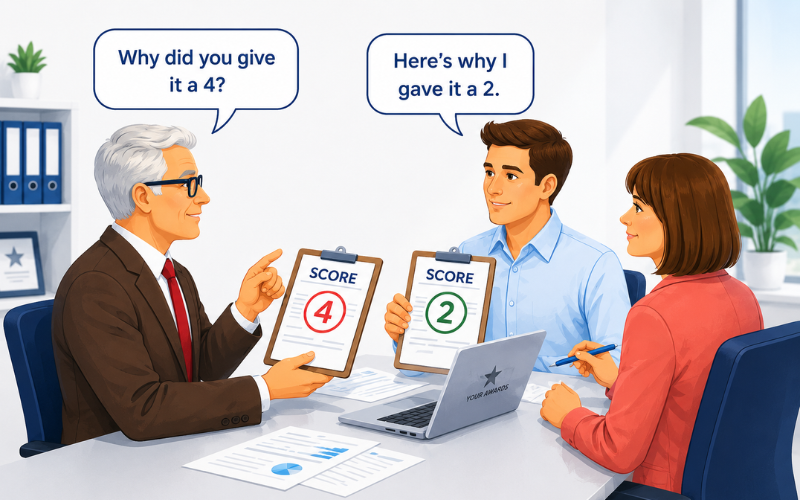
You’ve written clear criteria and recruited qualified judges. You’ve briefed them thoroughly on what each score level means but then the scores come in, and Judge A gives an entry a 4 while Judge B gives it a 2. This isn’t unusual, it happens in almost every program that skips calibration, and in many that think briefing alone is enough.
Judges interpret criteria differently, use scales differently, and weight factors differently, even when they’re looking at the same guidance documents. Calibration solves this by surfacing interpretation differences before they affect real evaluation. When judges score sample entries and then discuss their reasoning, hidden assumptions become visible. “I thought innovation meant technically novel” meets “I thought innovation meant new to this market“, and suddenly the gap between a 4 and a 2 makes sense.
The goal isn’t forcing artificial agreement because judges will and should bring different perspectives, but they need shared understanding of what criteria mean and how to apply the scale. Without that foundation, score variation reflects interpretation differences rather than genuine quality differences.
This guide covers how to run calibration effectively, from selecting sample entries to facilitating discussions to applying what you learn.
Why briefing alone isn’t enough
Program administrators often assume that clear criteria and thorough briefing will produce consistent scoring. The assumption is reasonable but wrong.
Written criteria have interpretation range
No matter how carefully you define criteria, language has flexibility. “Significant impact” means different things to different people. “Strong evidence” sets different thresholds for different judges. Written definitions narrow interpretation range but don’t eliminate it.
Judges bring different reference points
A judge who’s seen hundreds of award entries has different calibration than one judging for the first time. An enterprise executive and a startup founder have different baselines for what constitutes “innovative.” These reference points shape interpretation even when judges read identical criteria.
Scale usage varies systematically
Some judges use the full scale, including 1s and 5s when warranted. Others avoid extremes and cluster around the middle. Some are consistently generous; others are consistently harsh. These patterns are stable within judges but differ dramatically across judges.
Reading isn’t internalising
Judges may read briefing materials and believe they understand, then apply that understanding differently when facing actual entries. The gap between intellectual comprehension and practical application only becomes visible when judges try to use what they’ve learned.
Calibration reveals what briefing can’t
Calibration works because it’s experiential rather than informational. Judges don’t just read about what a 4 means, they score an entry, discover their 4 is someone else’s 2, and discuss why. That discussion creates understanding that reading alone doesn’t achieve.
Selecting sample entries for calibration
The entries you use for calibration shape what judges learn from the exercise. Selection matters.
Characteristics of good calibration entries
Representative of actual entries. Samples should resemble what judges will evaluate, similar format, similar length, similar complexity. Calibrating on simplified examples doesn’t prepare judges for real evaluation.
Spanning quality levels. Include samples across the quality spectrum. An excellent entry shows what high scores look like. A mediocre entry shows the middle. A weak entry establishes the low end. Single-point calibration doesn’t give judges the range they need.
Containing ambiguity. The most useful calibration entries have elements that could reasonably be interpreted differently. Clear-cut entries produce easy agreement but don’t reveal interpretation differences. Entries with debatable aspects generate discussion that surfaces hidden assumptions.
Covering key criteria. Ensure samples allow judges to practice applying each major criterion. An entry that excels on innovation but lacks impact evidence lets judges calibrate on both dimensions.
Sources for sample entries
Past program entries. Previous submissions provide realistic samples with known scoring history. You can compare calibration scores to actual results from past judging.
Anonymised real entries. Current-cycle entries can work if anonymised and removed from regular evaluation. However, this creates risk that judges encounter them later and recognise them.
Constructed examples. Purpose-built calibration entries can be designed to highlight specific interpretation challenges. They take effort to create but can be reused across cycles.
Public case studies. Industry case studies or award entries from other programs (where publicly available) can serve as samples, though they may not perfectly match your entry format.
How many samples?
For most programs, two to three samples provide sufficient calibration without excessive time investment. One excellent entry, one mediocre entry, and one weak or borderline entry cover the quality spectrum.
If your program has distinct category types with different evaluation dynamics, you may need category-specific samples. Technical innovation categories and marketing effectiveness categories may require separate calibration.
Calibration session formats
Calibration can happen synchronously (live discussion) or asynchronously (independent work with written comparison). Each format has trade-offs.
Synchronous calibration
Judges meet, virtually or in person, to discuss sample entries together.
How it works:
- Judges receive sample entries in advance
- Each judge scores samples independently before the session
- During the session, scores are compared (often anonymously at first)
- Discussion explores where scores diverged and why
- The group works toward shared understanding of criteria and scale application
Advantages:
- Real-time discussion surfaces nuance that written exchange misses
- Questions get answered immediately
- Builds panel cohesion and shared commitment
- Facilitator can guide discussion toward productive outcomes
Challenges:
- Scheduling is difficult with busy professionals across time zones
- Dominant personalities may overwhelm quieter judges
- Requires skilled facilitation to keep discussion productive
- Time-limited format may not resolve all differences
Best for:
- Smaller judge panels where scheduling is manageable
- High-stakes programs where consistency matters most
- First-time judge panels who benefit from relationship building
- Programs with complex or ambiguous criteria
Asynchronous calibration
Judges complete calibration independently, with written materials facilitating alignment.
How it works:
- Judges receive sample entries and score independently
- Judges submit scores with written reasoning for each
- Program administrators compile results showing score distributions and reasoning
- Judges receive the compilation and reflect on differences
- Administrators provide clarification notes addressing common interpretation differences
Advantages:
- No scheduling coordination required
- Works across time zones and schedules
- Written reasoning creates documentation
- All judges contribute equally (no dominance dynamics)
Challenges:
- Less interactive, nuances may not get resolved
- Judges may not engage deeply with comparison materials
- No opportunity for real-time clarification
- Slower feedback loop
Best for:
- Large or geographically distributed judge panels
- Programs where synchronous sessions aren’t feasible
- Experienced judge panels with established familiarity
- Lower-stakes programs where some variation is acceptable
Hybrid approaches
Combine formats to capture benefits of both:
- Asynchronous scoring, synchronous discussion. Judges score independently, then meet briefly to discuss only the highest-divergence items. This focuses synchronous time on areas that need it most.
- Synchronous kickoff, asynchronous follow-up. A brief live session establishes baseline alignment, with written materials addressing remaining gaps after judges have started real evaluation.
- Tiered calibration. All judges complete asynchronous calibration; a subset participates in deeper synchronous discussion and cascades learning to others.
Facilitating calibration discussions
Live calibration sessions require skilled facilitation to produce useful outcomes.
Setting the right tone
Normalise disagreement. Open by acknowledging that score variation is expected and valuable. The purpose is understanding differences, not punishing them. Judges who fear judgement for “wrong” scores won’t engage honestly.
Emphasise learning over correctness. There often isn’t a single right answer. The goal is shared understanding, not determining who was right and who was wrong.
Value all perspectives. Different interpretations often reflect legitimate viewpoints. A judge who scored lower may have noticed weaknesses others missed. Honour that contribution.
Revealing scores effectively
Anonymous initial display. Show score distribution without attributing scores to specific judges. This allows honest discussion without personal defensiveness.
Focus on spread, not individuals. “We have scores ranging from 2 to 4 on this criterion” invites exploration. “Judge Smith gave this a 2” invites defensiveness.
Delay personal attribution. Once discussion is flowing, judges often volunteer their reasoning. Let this happen naturally rather than calling on specific judges to explain.
Exploring divergence
Ask open questions. “What did people who scored higher see in this entry?” and “What concerns did lower scorers have?” invite explanation without judgement.
Probe underlying assumptions. When judges disagree, often they’ve made different assumptions about context, standards, or criteria meaning. Surface these: “It sounds like you were comparing to industry standard while others compared to this category’s typical entries, is that right?”
Seek the specific. Vague explanations (“I just felt it was weaker”) don’t help alignment. Push for specifics: “What specifically made you feel that way?”
Moving toward alignment
Identify agreed principles. Even when scores differ, underlying principles often overlap. Capture these: “So we agree that strong evidence should include third-party verification, the difference is whether this entry’s evidence meets that bar.”
Clarify criteria where needed. If discussion reveals genuine ambiguity in criteria definition, address it: “Based on this discussion, let’s clarify that ‘innovation’ in this category means novel approach rather than incremental improvement.”
Acknowledge remaining legitimate variation. Some differences reflect genuine judgement calls where reasonable evaluators disagree. That’s acceptable, the goal is reducing arbitrary variation, not eliminating all disagreement.
Time management
Calibration discussions can expand indefinitely. Structure time deliberately:
- Allocate specific time per sample entry
- Prioritise high-divergence criteria for deeper discussion
- Accept that not every difference will be resolved
- Reserve time at the end to summarise key takeaways
A focused 45-minute session produces more value than an unfocused two-hour session that loses judge attention.
What to do with calibration results
Calibration generates insights that should improve judging. Don’t let them evaporate after the session ends.
Update guidance materials
If calibration revealed criteria ambiguity, revise the criteria definitions or add clarifying examples. Future judges, and current judges during evaluation, benefit from this refinement.
Before calibration: “Evaluate the impact of this initiative.”
After calibration: “Evaluate the impact of this initiative. Strong entries demonstrate specific, measurable outcomes with supporting evidence. Impact should be assessed relative to the initiative’s scope and resources, a small team achieving modest but verified results may score as well as a large team achieving proportionally larger results.”
Create calibration reference points
Document the sample entries and the aligned interpretation of how they should be scored. These become reference points judges can revisit during real evaluation.
“The calibration entry from TechCorp was rated 4 on innovation because it introduced a genuinely new approach to the problem. Entries that refine existing approaches without fundamental novelty would score 3 or below.”
Address scale usage patterns
If calibration revealed that some judges cluster scores while others use the full range, address this directly:
- Remind judges to use the full scale when warranted
- Provide anchor descriptions that make extreme scores feel legitimate
- Consider whether your scale design contributes to clustering
Adjust for systematic differences
If certain judges consistently score higher or lower than others, and calibration doesn’t resolve this, statistical normalisation can adjust for these patterns when aggregating scores. This is a backup for differences that calibration doesn’t fix, not a substitute for calibration itself.
Share learnings with all judges
If only some judges participated in synchronous calibration, distribute the key takeaways to the full panel. Written summaries of calibration discussions help judges who weren’t present benefit from the conversation.
Ongoing calibration versus one-time calibration
Most programs calibrate once before judging begins. But calibration can also happen during evaluation.
Mid-judging check-ins
After judges have completed some entries, review score patterns:
- Are scores clustering where expected?
- Do any judges show dramatic patterns (all high scores, all low scores)?
- Are certain criteria producing more variation than others?
If patterns suggest drift or inconsistency, a brief mid-judging calibration can address problems before they affect more entries.
Real entry calibration
Some programs use actual entries for ongoing calibration rather than separate samples:
Overlap entries. Assign some entries to all judges (or all judges within a category). Compare scores on these shared entries to monitor consistency throughout judging.
Calibration entries embedded in assignment. Designate certain entries as calibration benchmarks. Judges score them alongside regular entries, and administrators compare results.
When ongoing calibration makes sense
- Large programs where initial calibration may not hold across many weeks of judging
- First-year programs where you’re learning what produces consistency
- Programs with inexperienced judges who may need reinforcement
- Categories where criteria are particularly complex or subjective
When one-time calibration suffices
- Smaller programs completed in a short window
- Experienced judge panels with established familiarity
- Categories with clear, well-defined criteria
- Programs where additional calibration burden isn’t justified by consistency gains
Common calibration mistakes
Treating calibration as optional
“We’ll do it if we have time” usually means it won’t happen. Build calibration into the program schedule as a required step, not an optional enhancement.
Using unrealistic samples
Calibration on simplified or artificial entries doesn’t prepare judges for real evaluation. Samples should reflect actual entry complexity, format, and challenge.
Skipping score discussion
Revealing that scores differed without exploring why misses the point. The discussion is where alignment happens. Score comparison alone just shows the problem without solving it.
Forcing false consensus
Pressuring judges to agree on a single “correct” score can suppress legitimate perspective diversity. The goal is shared understanding of criteria and scale, not identical judgements.
Neglecting to apply learnings
Calibration insights that don’t inform guidance updates, reference materials, or judging instructions are wasted. Capture and use what you learn.
Calibrating only at the start
For longer judging periods, initial calibration may not hold. Drift happens. Check consistency during judging, not just before it.
Making calibration punitive
If judges feel that calibration is testing them, that divergent scores will be held against them, they’ll game toward perceived expectations rather than honestly revealing their interpretations. Frame calibration as collaborative learning, not evaluation.
Checklist
Calibrating judges effectively
Preparation
- Sample entries selected spanning quality levels
- Samples representative of actual entry format and complexity
- Calibration session scheduled before judging begins
- Format chosen (synchronous, asynchronous, or hybrid)
- Facilitation approach planned if synchronous
Sample distribution
- Samples distributed with sufficient time for independent scoring
- Scoring sheets or forms provided
- Judges instructed to score independently before any discussion
- Written reasoning requested alongside scores
Session execution
- Scores compiled showing distribution and divergence
- Discussion focused on understanding differences, not assigning blame
- Key interpretation differences identified and explored
- Criteria clarifications documented where needed
- Time managed to cover priority items
Applying results
- Guidance materials updated based on calibration insights
- Reference points documented for judge use during evaluation
- Learnings shared with all judges (including non-participants)
- Scale usage patterns addressed if problematic
Ongoing monitoring
- Plan for mid-judging consistency checks
- Overlap entries assigned if ongoing calibration warranted
- Response protocol defined if drift is detected
Conclusion: Making calibration work
Calibration isn’t complicated, but it does require deliberate effort. The core insight is simple: judges interpret criteria differently even when they’ve read the same briefing documents, and a 4 from one judge and a 2 from another often reflects different assumptions rather than genuine disagreement about quality. Effective calibration means selecting sample entries that span the quality spectrum, choosing a format that fits your panel (synchronous for depth, asynchronous for distributed teams, hybrid for balance), and facilitating for learning rather than compliance. The goal isn’t forcing judges to agree on “correct” scores, it’s building shared understanding of what criteria mean and how to apply the scale.
What separates programs that get this right from those that don’t is follow-through. Update criteria definitions where ambiguity emerged. Document reference points judges can revisit during evaluation. Address scale usage patterns if some judges cluster while others use the full range. And don’t assume one calibration holds forever, for longer judging periods, consider mid-judging check-ins or overlap entries that let you monitor consistency throughout. Programs that treat calibration as essential infrastructure rather than optional enhancement produce scores that reflect genuine quality differences, which is the foundation of results you can explain and defend.
Related reading:
→ How to write judging criteria that judges can actually use
→ What to do when judges disagree on scores
→ Judging & Scoring Best Practices
Frequently Asked Questions
Judges interpret language, standards, and scales differently, even when they receive the same written guidance. Terms like “strong evidence” or “significant impact” allow room for interpretation, and judges bring different professional backgrounds, reference points, and expectations to those terms.
In addition, scale usage varies systematically. Some judges use the full scoring range, while others avoid extremes and cluster around the middle. Without calibration, score variation often reflects differences in interpretation and scale habits rather than real differences in entry quality.
Judge calibration is a structured process where judges score sample entries and then compare and discuss their reasoning before evaluating real submissions. The purpose is to surface hidden assumptions about criteria meaning, scale usage, and quality thresholds.
Calibration does not aim to force identical scores. Instead, it creates shared understanding of how criteria should be applied and what different score levels represent. This reduces arbitrary variation and ensures score differences reflect genuine quality differences rather than inconsistent interpretation
Effective calibration samples should:
- Resemble actual submissions in format, length, and complexity
- Span the quality spectrum (excellent, average, weak)
- Include ambiguous elements that reasonably invite different interpretations
- Allow judges to apply all major criteria
Using overly simple or artificial examples limits the value of calibration. Realistic, nuanced samples generate the discussions that reveal how judges are interpreting criteria in practice.
Calibration can be synchronous (live discussion), asynchronous (independent scoring with written comparison), or hybrid.
- Synchronous sessions enable real-time discussion and deeper alignment but require scheduling and skilled facilitation.
- Asynchronous formats are easier logistically and ensure equal participation but may lack nuance.
- Hybrid approaches combine independent scoring with focused live discussion on high-divergence areas.
The right format depends on panel size, time zones, program stakes, and judge experience.
Effective calibration discussions focus on understanding, not correcting, differences. Scores should initially be displayed anonymously to reduce defensiveness, and conversation should explore the reasoning behind higher and lower scores.
Facilitators should probe underlying assumptions, such as whether judges are comparing entries to industry standards or to typical submissions in the category. The goal is to clarify shared principles and refine criteria interpretation, not to pressure judges into artificial consensus.
Calibration findings should directly improve the judging process. Organisers should:
- Clarify ambiguous criteria language
- Add concrete examples to guidance materials
- Document reference points for score levels
- Address systematic scale usage patterns
Without updating materials or reinforcing alignment, calibration insights are lost. The discussion should result in practical changes that improve scoring consistency.
For short programs with experienced panels, one pre-judging calibration session may be sufficient. However, longer programs or first-time panels may benefit from ongoing monitoring.
Options include mid-judging check-ins, reviewing score distributions for drift, or assigning overlap entries scored by all judges to compare consistency. Ongoing calibration helps prevent alignment from weakening over time, particularly in complex or subjective categories.
Common calibration failures include:
- Treating calibration as optional rather than mandatory
- Using unrealistic or overly simplified sample entries
- Comparing scores without discussing the reasoning behind them
- Forcing false consensus instead of encouraging shared understanding
- Failing to apply lessons to updated guidance
- Framing calibration as evaluative or punitive
When handled properly, calibration is a collaborative alignment exercise. When mishandled, it becomes either a superficial formality or a source of defensiveness that undermines honest judging.