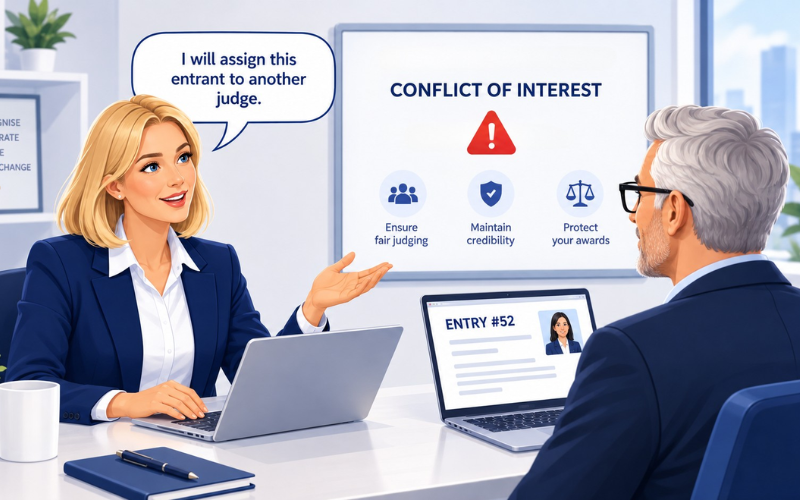
Every industry is smaller than it looks from outside. Your judges will know your entrants, because they’ve worked together, competed against each other, sat on panels together, or crossed paths at the same conferences for fifteen years. Some are friends. Some are rivals. Some have financial relationships that aren’t visible from the outside at all.
This is normal rather than scandalous, since in any specialist field the people qualified to judge are the same people who know everyone worth judging, and complete separation between evaluators and evaluated is usually impossible.
The answer isn’t to pretend conflicts don’t exist. It’s to manage them systematically: identify them before judging starts, decide which require recusal and which require disclosure, and build accountability that participants and observers can actually see.
On this page
- What counts as a conflict
- Disclosure or recusal?
- Building the process
- Conflicts discovered mid-process
- The problem with small industries
- Communicating about conflicts
- Common mistakes
- The conflict management checklist
What counts as a conflict
A conflict exists where a judge has a relationship, interest or circumstance that could bias their evaluation — or that could reasonably appear to bias it, even where no actual bias occurs.
That second half is the part programs underestimate. A judge may genuinely assess a former employer fairly, but anybody who knows about the relationship will question whether the score was objective, and the perception damages your credibility whether or not the conflict changed anything.
Conflicts fall into five families.
| Type | What it looks like | Why it’s a problem |
|---|---|---|
| Employment | Current employer, recent former employer, active discussions about joining an entrant, or a parent or subsidiary relationship | The clearest category, and the one nobody disputes. Corporate structures can hide the parent and subsidiary cases, so ask about them explicitly |
| Financial | Equity or options in an entrant, a board or advisory seat, recent consulting work, or a contract currently being negotiated | The judge benefits directly from the entrant’s success, which is the definition of the problem |
| Personal | Family, close friends, and long-standing mentor or mentee relationships | Loyalty operates below conscious intent, and nobody can reliably audit their own objectivity here |
| Competitive | A direct competitor, or a rival whose recognition would undermine the judge’s own market positioning | This one runs the opposite way — the risk is scoring a competitor harshly rather than generously, which is harder to spot |
| Professional and reputational | Public advocacy for or against the approach an entry uses, paid speaking at entrant events, co-authorship, or reciprocity from previous cycles | Somebody who has written critically about a methodology will struggle to award it top marks, however fair-minded they are |
The reciprocity case deserves particular attention in industries where the same people rotate between judging one year and entering the next, because an unspoken “I scored you well last year” is impossible to prove and corrosive if anybody suspects it.
Disclosure or recusal?
Not every conflict warrants the same response, and treating them identically is as damaging as ignoring them — it either removes half your panel unnecessarily or leaves serious conflicts unmanaged.
| Recuse automatically | Disclose, then decide |
|---|---|
| Current employment with an entrant | Former employment, after an appropriate separation period |
| Immediate family involved with an entrant | Indirect competitive relationships |
| Direct financial interest, including equity and pending contracts | Professional acquaintance through normal industry involvement |
| Active consulting or advisory relationships | Past collaborative work, such as co-panellists or co-authors |
| Direct supervisory or reporting relationships with whoever submitted the entry | Conference speaking at an entrant’s event |
| Head-to-head competition for the same customers or contracts | Broader sector overlap without direct competition |
Competition is the row that needs judgement, because in most industries nearly everybody competes with nearly everybody at some level, so the test is whether the judge’s organisation is actually chasing the same business as the entrant, rather than whether they appear in the same market reports.
For anything in the left column, no amount of good intention overcomes the perception problem, so the judge comes off those entries regardless of how confident they are in their own objectivity.
The right column is a judgement call, and where you land depends on your program’s standards. Some organisers recuse for any disclosed relationship at all, which is clean but expensive in a small field. Others permit evaluation with the disclosure recorded and monitored. Either is defensible as long as you apply it consistently.
Building the process
Conflict management has to be systematic rather than a series of judgement calls made under time pressure, and there are four stages to build.
Collect disclosures before judging opens
Do this while judges can still be reassigned without disrupting anything, using three tools together.
A disclosure questionnaire that sets out the conflict types and asks judges to flag any that apply, because you can’t rely on judges to identify what counts — many won’t recognise the relationships that concern you.
An entrant list review, where you share the entrants or at least the entrant organisations and ask judges to identify any connections. People genuinely forget relationships until prompted by a specific name.
A formal attestation confirming they’ve disclosed everything relevant, which creates accountability and signals that you take this seriously rather than treating it as paperwork.
Evaluate what comes back
Sort disclosures into automatic recusals and judgement calls, applying the same standard to similar relationships. Document which conflicts triggered recusal, which permitted evaluation with disclosure, and your reasoning in each case — that record is what gives you consistency this year and defensibility next.
Then tell judges where they’ve landed. Anyone who disclosed something that didn’t lead to recusal should know their disclosure was noted and valued, or they’ll wonder whether it was worth mentioning.
Assign entries accordingly
Conflicted judges shouldn’t see affected entries in their queue at all, rather than being trusted to skip them. After the exclusions, redistribute so the workload stays reasonable, and then verify that every entry still has enough unconflicted judges on it.
Monitor while judging runs
Give judges an easy way to report something they’ve discovered mid-review — “I started reading this and realised I know the project lead” — because the alternative is that they either say nothing or email whoever they can find.
Watch your score patterns too, since a judge scoring one entry dramatically differently from everybody else may warrant a look. And if you know the industry yourself, use that: administrators often spot relationships that judges didn’t think to mention.
Conflicts discovered mid-process
However good your upfront process, some conflicts surface after judging has begun, and how you handle them matters more than the conflict itself.
When a judge self-reports
- Stop evaluation of the affected entry. The judge shouldn’t continue scoring where the conflict exists.
- Deal with work already done. If scores have been submitted for that entry, remove them from the aggregation.
- Reassign the entry to an unconflicted judge, so coverage holds.
- Thank them. Self-reporting takes integrity, and how you respond determines whether the next judge bothers.
That fourth step is the one programs skip, and skipping it is expensive. A judge who feels their honesty created a problem for you will quietly say nothing next time.
When you discover it yourself
Investigate before assuming bad faith, because judges frequently fail to recognise a relationship as relevant — somebody who didn’t declare a competitor relationship may simply not have thought of competitive dynamics as conflicting at all.
Your options then run from removing scores already submitted, through reassigning that judge’s remaining entries involving the entrant, to removing them from the panel entirely in serious cases. Document what you found, what you did and why, since that record is your protection if the decision is questioned later.
When it emerges after results are announced
This is the hardest version. Start by assessing whether the affected judge’s scores would have changed the outcome, because if they wouldn’t have, you can disclose the conflict without revisiting the result.
If they were decisive, you’re choosing between noting the conflict in your documentation and revising the result, and revision after announcement is extremely difficult — it damages a winner who did nothing wrong and creates a public complication that outlives the correction. Reserve it for clear cases where the outcome was materially affected.
Either way, a post-judging discovery tells you something about your disclosure process, so update the questionnaire or the verification step to catch that type of relationship next cycle.
The problem with small industries
In a tight-knit field, the pool of qualified judges overlaps heavily with the pool of likely entrants, and insisting on complete separation leaves you with judges who don’t know enough to evaluate anything.
So in a small industry the goal changes from eliminating conflicts to managing them visibly, which means four things in practice.
Accept disclosure rather than perfection
Some relationships will exist whatever you do, so put your effort into transparency about them instead of pretending they’re avoidable.
Hold clear bright lines
Even where you permit evaluation with disclosure for minor conflicts, keep automatic recusal absolute for the serious categories. A rule with no exceptions is worth more than a rule with several.
Rotate your panels
Changing the composition between cycles stops relationship patterns becoming entrenched, and it removes any suggestion that the same people reward each other year after year.
Document consistently
Where a conflict is permitted with disclosure, the documentation is the only thing standing between you and an accusation if somebody asks about it in twelve months.
Communicating about conflicts
How you talk about conflict management affects your credibility almost as much as the management itself.
To your judges, be explicit about what needs disclosing, what happens to a disclosure once it’s made, and the fact that disclosing is valued rather than penalised. Give them an easy channel for anything they spot mid-process. Judges who understand the process comply with it; judges who don’t, guess.
To your entrants, describe your approach without naming individual judges or disclosures, explain that judges with relationships to entrants are recused, and offer a route to raise a concern. Entrants who know conflicts are handled systematically are considerably slower to assume the worst about a result they didn’t like.
To everybody else, reference your disclosure and recusal policies rather than making claims about purity.
Common mistakes
Six patterns account for most of the damage.
Relying on self-identification alone
Judges don’t always recognise what counts, so an entrant list and specific disclosure questions catch what an open-ended request misses.
Treating all conflicts identically
A former employer isn’t the same as having attended the same conference, and blanket policies produce worse outcomes than graded ones.
Documenting nothing
Decisions made verbally and never recorded drift out of consistency, and leave you with no evidence when somebody questions one.
Avoiding the difficult conversation
When the conflict involves your most prominent judge there’s a real temptation to let it go, and that’s precisely the case where applying the policy matters most.
Recusing without reassigning
Taking a judge off an entry and not replacing them leaves a coverage gap that shows up as a thinly scored category.
Over-reacting in public
If a conflict becomes public, a dramatic response implies the program was compromised. Acknowledge it, explain how it was managed, and show the process worked.
The conflict management checklist
Conflict management for awards programs
Pre-judging disclosure
- Conflict categories defined clearly
- Disclosure questionnaire sent to every judge
- Entrant list shared for relationship review
- Formal attestation collected
- Disclosure deadline set before judging opens
Conflict evaluation
- Automatic recusal triggers defined
- Criteria established for disclosure with continued evaluation
- All disclosures reviewed by administrators
- Decisions documented with reasoning
- Judges informed of recusals and final assignments
Entry assignment
- Conflicted judges excluded from affected entries
- Coverage verified after exclusions
- Workload rebalanced across remaining judges
- Additional recruitment completed where gaps exist
During judging
- Self-reporting channel available and communicated
- Score patterns monitored for anomalies
- Administrator review for undisclosed relationships
- Response process defined for mid-process discoveries
Documentation
- All disclosures recorded
- All recusal decisions documented
- Mid-process discoveries and responses logged
- Records retained for future cycles
Communication
- Judges understand the expectations and the process
- Entrants informed about fairness measures
- External communications reference conflict management
- Tone reflects management rather than elimination
Manage them, don’t deny them
Every judging context has conflicts in it, and the programs that get into trouble are rarely the ones with the most relationships — they’re the ones that never wrote any of it down.
Decide your bright lines before you need them, ask specific questions rather than open ones, record every decision and the reasoning behind it, and thank the judges who raise their hand. Do that consistently and a conflict stops being a threat to your credibility and becomes evidence of it.
Continue learning
- How to recruit and brief award judges effectively — conflict management starts with selection, and this covers recruiting for independence and building balanced panels.
- How to reduce bias in awards judging — conflicts are one source of bias among several, and this covers the structural approaches to the rest.
- Awards program governance: who should own what — conflict management is a governance function, and clear ownership protects the program.
- Judging and scoring best practices — the complete guide to judging processes that produce defensible outcomes.
Frequently Asked Questions
Former employment does not always require automatic recusal, but it must be disclosed and assessed carefully. The appropriate separation period depends on the judge’s previous role and level of influence. A junior employee who left six months ago may present less risk than a senior executive who shaped company strategy and left recently.
The key consideration is whether a reasonable observer would question impartiality if the relationship became public. If the connection appears significant or recent enough to undermine confidence, recusal is the safer option.
Even when no real bias exists, perceived conflicts can damage an awards program’s credibility. Audiences, entrants, and sponsors judge fairness not only by outcomes but by whether the process appears impartial.
If a judge awards a prize to a former employer or close associate, observers may question the integrity of the result, regardless of the quality of the entry. Once trust in impartial judging is weakened, restoring credibility is difficult. Managing perception is therefore as important as managing actual bias.
Disclosure means a judge declares a potential conflict, but may still evaluate the entry if administrators determine the relationship is minor and manageable. Recusal means the judge is completely removed from evaluating that specific entry.
Recusal is required for serious conflicts such as current employment or direct financial interests. Disclosure with continued evaluation may be appropriate for less severe relationships, such as past collaborative work or indirect competitive dynamics, provided the program documents the decision and applies standards consistently.
Effective conflict management starts with structured pre-judging procedures:
- Provide a detailed disclosure questionnaire listing specific conflict categories
- Share the entrant list so judges can identify overlooked relationships
- Require formal attestation confirming full disclosure
- Review and categorise disclosures before assigning entries
Collecting this information early allows administrators to reassign entries without disrupting the judging process and ensures every entry receives evaluation from unconflicted judges.
If a judge identifies a conflict mid-process, they should immediately stop evaluating the affected entry. Any submitted scores for that entry should be removed from aggregation, and the entry reassigned to an unconflicted judge.
When administrators discover an undisclosed conflict, they should investigate calmly, determine whether the oversight was inadvertent, and decide whether to remove scores, reassign entries, or in serious cases remove the judge entirely. All actions should be documented to protect program credibility.
In specialist industries, complete separation between judges and entrants is often unrealistic because the most qualified experts are also deeply embedded in the sector. The goal shifts from eliminating conflicts to managing them systematically.
Best practice includes:
- Accepting disclosure as normal rather than aiming for zero relationships
- Maintaining clear automatic recusal rules for serious conflicts
- Rotating judging panels across cycles
- Documenting all decisions consistently
This approach preserves expertise while protecting credibility through transparency and structured oversight.
Transparency builds trust. Awards programs should clearly explain that judges are required to disclose relationships and that conflicted judges are recused from relevant entries. Entrants should have a channel to raise concerns about potential conflicts.
Public communications should avoid unrealistic claims such as “no conflicts exist.” Instead, credible messaging acknowledges that conflicts are common in specialist industries and emphasises that they are identified, documented, and managed systematically.