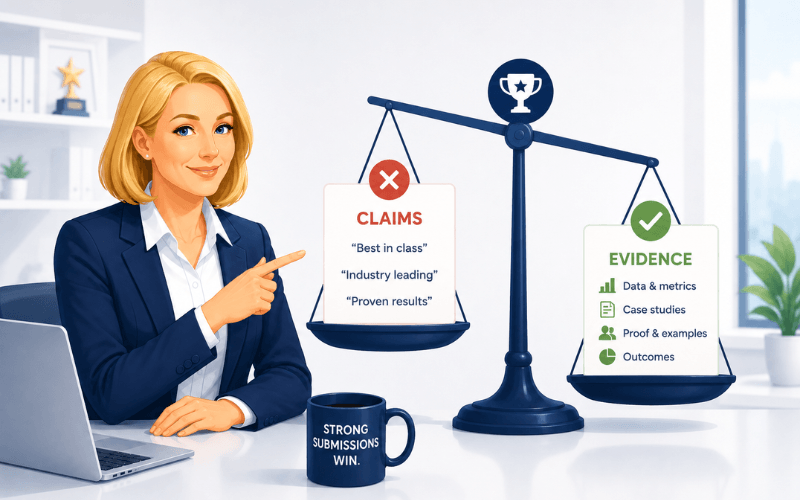
“Significant improvement.” “Industry-leading results.” “Exceptional customer satisfaction.” “Transformational impact.” Every awards program collects these phrases by the hundred, and the difficulty is that they tell judges almost nothing at all.
The problem isn’t that entrants are being dishonest, because most of them genuinely believe their achievements deserve recognition. The problem is that entry processes rarely require substantiation, so when a form asks entrants to describe their impact without prompting them for proof, they describe impact in the vaguest and most favourable terms available to them.
That leaves your judges with three bad options. They can accept every assertion at face value, or they can discount everything that isn’t proven, or they can read between the lines and guess at what’s real. None of the three produces scoring that is consistent, and none of them produces scoring you could defend if an entrant rang up to ask how a decision was reached.
The fix sits in your entry design rather than in your judging, because if you want evidence you have to ask for it explicitly, build structures that make substantiation the natural response, and signal clearly that unsupported claims won’t be enough.
On this page
- Why claims dominate and evidence disappears
- Designing entry forms that elicit evidence
- Signalling that evidence matters
- Question techniques that prompt evidence
- Handling common evidence challenges
- Training judges to value evidence
- Building a culture of substantiation
- Balancing evidence against burden
Why claims dominate and evidence disappears
There are four reasons entries drift towards assertion and away from proof, and because each one has its own design fix, it’s worth working out which of them is at play in your program before you start rewriting questions.
Your form doesn’t ask for it
If you ask entrants what impact they achieved, you’ll get a narrative description of impact, and the entrant has answered you perfectly well, the question simply didn’t require any proof.
Evidence also costs real effort, because entrants have to find the data, check that it’s accurate, get permission to quote the people they want to quote, and compile the documents. If your form doesn’t ask for that work, hardly anyone volunteers it.
Marketing habits carry over
A lot of entrants write their submission the same way they write everything else aimed at an outside audience, which means superlatives, confident assertions and broad claims of success, all of which feel completely natural to them.
This isn’t manipulation, it’s habit, and unless something in your guidance points them somewhere else, what you’ll receive is marketing copy.
Entrants don’t know what judges need
Most entrants have never sat on a judging panel, so they assume that impressive-sounding claims will be persuasive, without realising that a judge might read forty “transformational” submissions over a single weekend.
Read one at a time, a superlative looks strong. Read in aggregate, as your judges read them, the same superlatives cancel each other out and become noise.
Claims are simply easier
Writing “we achieved significant improvements in customer satisfaction” takes about ten seconds, whereas finding the satisfaction data, calculating the change, checking the methodology and presenting it clearly can take most of an afternoon.
When time is short and the form doesn’t insist on the harder version, the path of least resistance wins every single time.
Designing entry forms that elicit evidence
Your form is the main lever you have, because the questions you ask determine the answers you get, and no amount of guidance elsewhere will compensate for a question that lets entrants off the hook.
Ask for evidence explicitly
Don’t assume entrants will offer proof unprompted, and instead put the requirement into the question itself, so that there’s no ambiguity about what a complete answer looks like.
Invites a claim
“Describe the impact of your work.”
Invites evidence
“What measurable outcomes did you achieve? Give specific metrics, the methodology used to calculate them, the timeframe, and a comparison point such as before and after, against target, or against a benchmark.”
The second version tells entrants that vague claims won’t get them anywhere, and because it names what a good answer contains, they know they need numbers, method and context rather than just an assertion delivered with confidence.
Separate the claim from the proof
Paired questions work well here, because you can ask for the outcome first and then ask for the substantiation as a separate answer, which makes it much harder to skip.
Question 1: What results did this work achieve?
Question 2: What evidence supports those results? This might include the methodology behind any metrics you’ve cited, as well as third-party validation, customer testimonials, or documentation.
This structure accepts that entrants are going to make claims, and then it turns proving them into a visible, required field rather than an afterthought buried somewhere in a longer answer.
Name the evidence types you want
A general request for “evidence” can still produce a vague response, whereas naming the type you’re after gets you a specific one, and an entrant who freezes at “provide evidence” can usually answer “explain how these figures were calculated” without any trouble at all.
Evidence prompts you can paste into your form
- Provide the methodology used to measure the outcomes you’ve claimed.
- Include at least one testimonial from a customer, partner or stakeholder.
- Reference any third-party validation, accreditation or independent recognition, if you have it.
- Describe the data sources used and how the results were calculated.
- Give your starting point and your end point, with the dates for each.
- What feedback have customers or stakeholders given about this work?
Use supporting materials as evidence, not decoration
Written answers aren’t the only place proof can live, and uploads are useful precisely because they carry documentation that would be tedious to describe in prose, such as:
- Data summaries or dashboard screenshots
- Before-and-after comparisons
- Customer testimonials, with permission to quote
- Third-party reports or audit statements
- Media coverage or industry recognition
- Survey results or research findings
Whatever you’re hoping for, say so at the point where you ask for the upload, because an unlabelled upload field tends to attract brochures.
Upload documentation supporting the results you’ve claimed, such as data summaries, customer testimonials, or third-party validation.
Signalling that evidence matters
Form design gets you part of the way, and the rest comes from what your criteria, your guidance and your public communications tell entrants about how they’re going to be judged.
Weight evidence in your judging criteria
If evidence quality appears as a formal criterion then entrants know it counts, so it’s worth adding something like “quality of evidence” or “substantiation of claims” as an explicit scoring dimension.
Evidence quality: are the claimed outcomes supported by specific metrics, an explanation of methodology, or third-party validation? Judges will assess whether claims are credible and verifiable.
Publishing that criterion tells entrants plainly that unsupported claims will cost them points, and once that’s understood the incentive moves towards proof without you having to chase anybody.
Say it plainly in your entry guidance
Don’t assume entrants already know that vague claims are a problem, because most of them don’t, and a short paragraph explaining how judges think will do more good than any number of reminders about word counts.
Judges assess both what you achieved and whether you can prove it. Strong entries include specific metrics with an explanation of methodology, a timeframe, and a comparison point. Third-party validation, customer testimonials and independent recognition all strengthen a submission, whereas general claims without supporting evidence score lower, however impressive the claimed outcome.
Put that way, evidence starts to look like a strategic necessity rather than an optional extra, which is exactly the shift you’re after.
Show an example of evidence done well
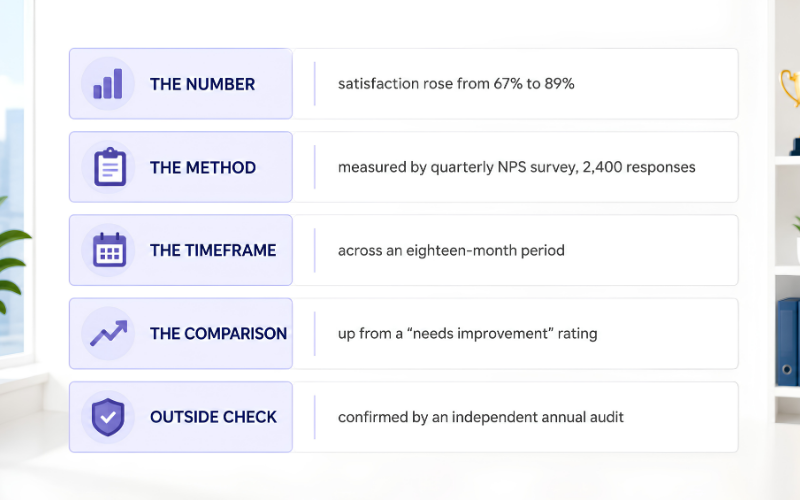
If you can share an anonymised example then entrants have a model to copy, and most people find it far easier to reverse-engineer a paragraph than to act on advice given in the abstract.
Customer satisfaction increased from 67% to 89%, measured through quarterly NPS surveys with 2,400 respondents and a 92% response rate. The results were validated by ServiceTrack’s annual audit, which rated us “exceptional”, up from “needs improvement” eighteen months earlier.
Question techniques that prompt evidence
Small changes in phrasing do most of the work here, and none of them add any length to your form, which matters if you’re already worried about how long the thing takes to complete.
| Instead of asking | Ask | What it forces out |
|---|---|---|
| What results did you achieve? | What results did you achieve, and how were they measured? | Data sources, methodology and validation, which is evidence |
| Describe the improvement. | Describe the improvement, including your starting point and your end point. | A quantified change rather than a direction of travel |
| Describe the impact of your work. | What measurable outcomes did you achieve? Include methodology, timeframe and a comparison point. | Numbers with the context needed to interpret them |
| Tell us about the response to this work. | What feedback have customers or stakeholders given? Include at least one testimonial from someone who experienced the results firsthand. | An external voice, which is harder to inflate than self-assessment |
| Why does this deserve to win? | Has this work received any independent recognition or validation? | Verifiable third-party judgement instead of self-advocacy |
Use word limits to your advantage
A tight word limit forces entrants to choose between promotional narrative and specific evidence, so as long as you tell them which way to choose, the limit does some of your work for you.
Space is limited, so prioritise specific metrics and evidence over general narrative. Judges weight specificity and proof more highly than descriptive language.
Handling common evidence challenges
Sometimes evidence is genuinely hard to produce, and if you don’t anticipate those situations you’ll end up penalising the honest entrant who had good reason to hold something back, while rewarding the one who simply made a number up.
Confidential or sensitive data
Some entrants can’t publish exact figures, so give them a route that still substantiates the claim rather than leaving them to choose between breaching a commercial agreement and saying nothing.
If exact figures are commercially sensitive, give percentage changes, indexed values or ranges instead. You can also describe results in relative terms, for example “doubled” or “reduced by more than half”, with a note explaining why the underlying figures are confidential.
Long-term or ongoing results
Not every outcome is measurable inside your entry window, and an initiative that won’t show its full effect for three years shouldn’t be excluded because of the calendar.
If final results aren’t yet available, give interim metrics, early indicators or projected outcomes with a clear explanation of method. Tell us where you are in the timeline as well as what evidence exists at this stage.
Qualitative achievements
Cultural change, relationship building and strategic positioning rarely reduce to a single figure, but that doesn’t make them unprovable, and the evidence is simply of a different kind.
Where an achievement is difficult to quantify, provide stakeholder testimonials, before-and-after comparisons of qualitative factors, or external recognition. Explain how you assessed the outcome in the absence of numerical metrics.
New or small-scale initiatives
Early-stage work simply hasn’t had time to accumulate data, so scale what you ask for to what could reasonably exist by now.
For newer initiatives, provide whatever evidence exists, such as preliminary results, pilot data or early indicators. Explain the timeline and what you expect to be able to demonstrate over time.
Training judges to value evidence
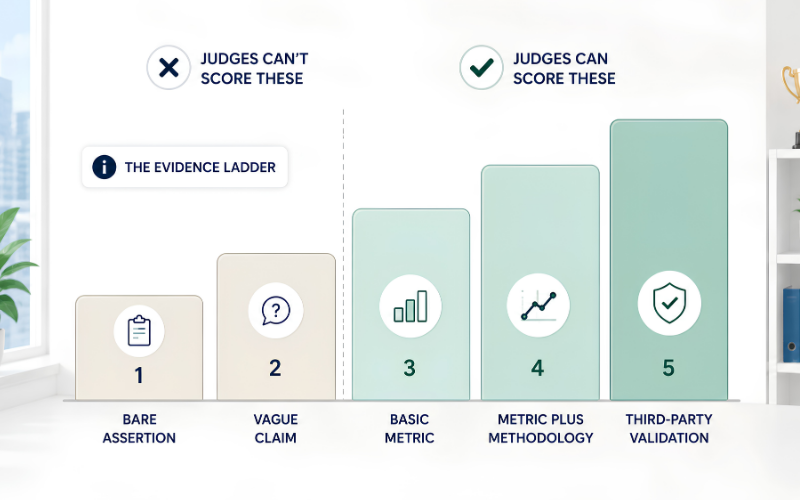
Better entry design gets better submissions in front of your panel, but it doesn’t guarantee that your panel will reward them, and a judge who is swayed by a confident, unproven narrative quietly undoes all the work you put into the form.
Calibrate on evidence quality
Work through a sample entry together before scoring opens, and settle these three questions as a panel while there’s still time to agree:
- What makes evidence credible, and what makes it insufficient?
- How should you handle an entry with strong claims but weak proof?
- How much weight should evidence carry relative to everything else?
Put evidence in the scoring rubric
If evidence quality is a criterion then your judges need to know what separates one score from the next, because otherwise you’ll get five people applying five different standards to the same pile of entries.
| Score | What it looks like |
|---|---|
| 5 — exceptional | Specific metrics with a clear methodology, third-party validation, multiple supporting sources |
| 4 — strong | Quantified outcomes with reasonable substantiation and some external validation |
| 3 — adequate | Basic metrics provided, with limited explanation of method or external proof |
| 2 — weak | Vague claims with minimal substantiation |
| 1 — none | Assertions with no supporting proof at all |
Ask judges to flag missing evidence
Encourage comments that name the gap rather than just recording a low score, because a note reading strong results claimed but not substantiated tells you exactly which question on your form failed to do its job, and gives you something concrete to fix before the next cycle opens.
Building a culture of substantiation
Expectations carry over from one cycle to the next, so what you say publicly about why entries won will shape how next year’s entrants write, often more than your guidance notes do.
Reference evidence when you announce winners
A line such as “selected for demonstrating measurable customer impact with third-party validation” tells everybody reading what actually mattered, and it costs you nothing to include.
Share the pattern with future entrants
If substantiated entries outperformed unsubstantiated ones then say so, because “entries with specific metrics and clear substantiation scored significantly higher than those relying on general claims” is far more useful to a returning entrant than general advice about writing well.
Make feedback specific about proof
If your program offers entrant feedback, note where the evidence was strong as well as where it was thin, since a comment like “your innovation claims were compelling but would benefit from independent validation” gives someone a concrete thing to do differently next time.
Balancing evidence against burden
Asking for evidence adds work for entrants, and that’s appropriate, because it improves the quality of what you receive and the accuracy of what your judges decide.
The risk to watch: demand too much and you’ll deter smaller organisations with limited resources, and you’ll end up with a shortlist that reflects who had a data team available rather than who did the best work.
There are four ways to hold that balance:
- Make some evidence optional. Core claims should require substantiation, whereas supporting detail can invite documentation without demanding it.
- Accept variety. A formal third-party audit isn’t the only valid form of proof, and customer quotes, media coverage, internal data and a sensible explanation of method all add credibility.
- Scale expectations to the category. High-stakes or technical categories can carry stricter evidence requirements, while community and creative categories may reasonably accept qualitative substantiation instead.
- Acknowledge real constraints. Guidance that recognises confidentiality, timing and scale reads as reasonable rather than demanding, and entrants tend to respond to it by giving you more than you asked for.
The goal was never perfect proof of every claim, because that isn’t achievable and chasing it would cost you entries. What you’re after is a meaningful shift from unsupported assertion towards credible substantiation, and even a modest improvement in evidence quality makes a large difference to how fairly your judges can evaluate what’s in front of them.
Frequently Asked Questions
Many award entries rely on broad claims because entry forms ask entrants to describe their achievements without requiring proof. As a result, applicants naturally focus on persuasive language rather than measurable evidence, leaving judges with assertions they cannot easily verify.
Programs can improve submission quality by designing questions that explicitly request data, methodology, and supporting documentation alongside every major claim.
The most effective approach is to ask entrants for measurable outcomes, explain how results were calculated, include relevant timeframes, and provide comparison points. Questions that require methodology and supporting proof make evidence a natural part of the submission rather than an optional extra.
This shifts entries away from promotional language and towards information judges can evaluate objectively.
Strong award entries support their claims with credible, verifiable evidence, such as:
Performance metrics with clear methodologies
Before-and-after comparisons
Customer or stakeholder testimonials
Third-party validation or industry recognition
Survey results, dashboards, or research findings
Providing multiple forms of evidence increases the credibility of the submission and helps judges assess achievements with greater confidence.
Using separate questions for outcomes and evidence encourages entrants to first explain what they achieved and then demonstrate how those achievements can be verified. This structure makes evidence a required part of the entry rather than an afterthought.
It also helps judges distinguish between well-supported achievements and claims that lack sufficient proof.
Award programs can include evidence quality as a formal judging criterion with its own weighting. By making substantiation part of the scoring process, entrants understand that unsupported claims are unlikely to receive high marks.
Publishing these expectations before entries open also encourages applicants to gather stronger data and documentation during the submission process.
Well-designed questions ask not only what happened, but also how the results were measured and verified. Asking for comparison points, methodologies, customer feedback, or third-party validation encourages entrants to provide specific, credible information instead of general descriptions.
Small changes in wording can significantly improve the quality and consistency of responses judges receive.
When exact figures cannot be shared, entrants can provide percentage changes, indexed values, ranges, or relative improvements while explaining why detailed numbers are confidential. For qualitative achievements, evidence such as testimonials, before-and-after comparisons, or external recognition can demonstrate impact.
Providing this flexibility allows organisations to substantiate their achievements without disclosing commercially sensitive information.
Judge training helps create a consistent standard for assessing evidence across all submissions. Calibration sessions, scoring rubrics, and discussions about what constitutes credible proof enable judges to distinguish between well-supported achievements and unsupported assertions.
This leads to fairer evaluations, more defensible results, and greater confidence in the overall awards program.